
 The interesting new book, New Directions in the European Fantastic (edited by Sabine Coelsch-Foisner) has been published by Winter Verlag. It includes my article titled “The Global and Local in Fantastic New Media: The Case of Finland”, which is based on the keynote I delivered in the EUROFAN conference. You can find more information about the book from these places at least:
Category: digital culture
Pelit, pelimaailmat ja fantasian kautta voimaantuminen
[In Finnish] Tässä on luentorunkoni Tieteen päivät 2013 -esityksestä “Pelit, pelimaailmat ja fantasian kautta voimaantuminen”. Muut puhujat sessiossa “Verkkomaailmat – uhka identiteetille vai voimaantumisen mahdollisuus?” olivat Janne Matikainen, Susanna Paasonen ja Tere Vadén.
Lantrek mediaseminaari
[Speaking about game culture studies in Lantrek event in Finnish] Lantrek 2013 pelitapahtuman yhteydessä järjestetään mediaseminaari “Pelaamisen ja oppimisen ulottuvuudet” huomenna 11.1.2013. Ohjelmassa on monta kiinnostavaa alustusta; oma luentoni on otsikoitu “Digitaalinen kulttuuri ja pelitutkimus”. Lantrek-sivut: http://www.lantrek.org/2013/
Edit: tässä on myös itse seminaarin ohjelma: Pelaamisen ja oppimisen ulottuvuudet -ohjelma.
Tieteen päivät: verkkomaailmat-sessio
[In Finnish] Tieteen päivät 2013 alkaa tänään ja tarjoaa jälleen laajasti erilaista mielenkiintoista tutkimustietoa ja keskustelua. Osallistun puheenjohtajana ja alustajana tällaiseen sessioon sunnuntaina, 13.1. klo 12:00-14:00 Helsingin yliopiston päärakennuksen salissa 5 (3. kerros), tervetuloa kuulemaan:
Verkkomaailmat – uhka identiteetille vai voimaantumisen mahdollisuus?
Puheenjohtaja: professori Frans Mäyrä (Tampereen yliopisto)
- Professori Frans Mäyrä (Tampereen yliopisto): Pelit, pelimaailmat ja fantasian kautta voimaantuminen
- Yliopistotutkija Janne Matikainen (Helsingin yliopisto): Identiteetti verkossa – keksittyä vai todellista?
- Professori Susanna Paasonen (Turun yliopisto): Trolleja, meemejä ja vihapuhetta – nettikeskustelujen tunnelataukset
- Professori Tere Vadén (Aalto-yliopisto): Kuinka monta ensimmäistä Internet-vallankumousta maailmaan mahtuu?
Tapahtumaan on vapaa pääsy.
Hybrid Touch
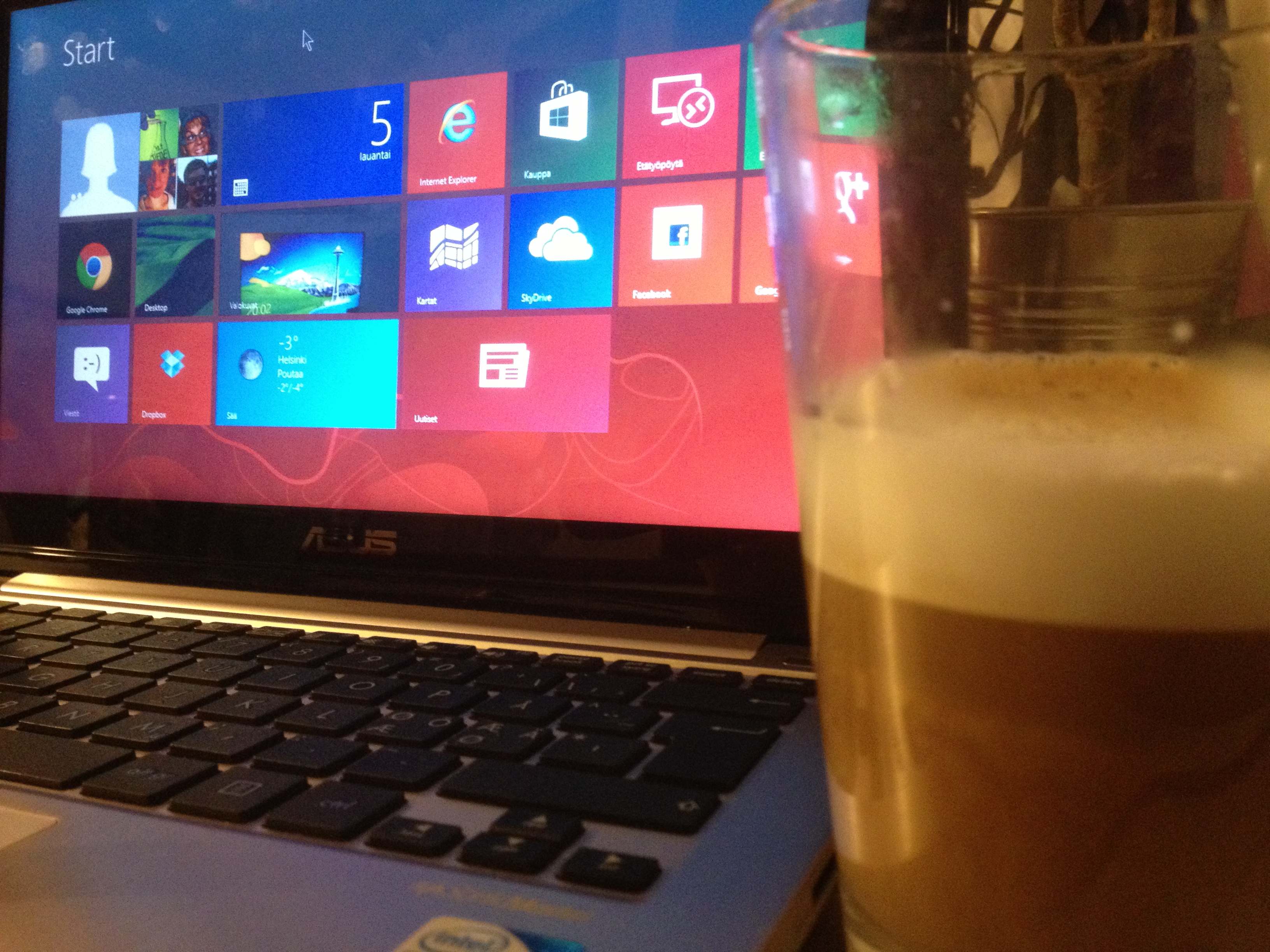
A new Windows laptop with a touch screen is an intriguing proposition. After a couple of days of playing around with my new ASUS Vivobook X202E, I am pretty convinced: there are few obvious challenges, but apart from those, this is clearly the direction our media and information use will be heading in the future.
It is not only about having screen and keyboard and a touchpad as alternative ways of interacting with the same old windows, settings, applications and services. The increased freedom in interaction modalities feels liberating, and having the new (“Metro”) interface and the classic desktop both available is also contributing to the feeling that using a computer is now fundamentally altered. The touch screen is probably just an intermediate step; there are already some systems that come with pattern and movement recognition software that will recognize gestures, and when we are in the millimeter class of precision (see: https://leapmotion.com/), there is nothing stopping developers from coming up with games and utilities that will react to a blink of an eye or wrinkle on a brow. Gestures will feel unnatural in some situations, spoken commands in some others, like mouse, keyboard or touch screen all have their non-optimal use contexts — but all together, all these increasing alteratives will make it more free and more natural to do what we want to do, where-ever we want to do that.
The hybrid interface of Windows 8 is an obvious work-in-progress thing. Sometimes you click something in the Metro tiles and are suddenly taken to the traditional desktop app. Sometimes you will find a Metro-looking UI element stuck in the middle of traditional Windows stuff. It is confusing, to say the least. But I find it exhilarating: finally we have something interesting happening, something new. And it is not obvious what the right solutions to these multiple challenges and problems (of interacting with a plethora of different functionalities, applications and services with multiple different interaction techniques) will be. So: there is going to be interesting times ahead! Already it puts a smile to my face when with a flick of a finger I jump from blog writing to spreadsheet and then into Angry Birds Space, that works beautifully, like many other touch-enabled games that I tested from the Windows Store.
This ASUS laptop itself is also a sort of compromise. If a really optimal, top-of-the-line ultrabook with a fast SSD, touch screen and all the latest bells and whistles costs here perhaps around 1200 euros, this thing was only half of that. The 11,6″ touch screen is fine for me: it is bright, sharp and responsive, even while there is light leaking through from the corners and viewing angles are far from perfect. The processor could be speedier, there could be more memory (there is 4 GB), and the keyboard definitely would profit from backlit keys, but I am not complaining too much. The battery is too small to keep up on the road (it goes for maybe 3-4 hours and cannot be replaced by user), but I will be using this thing in home. The hard drive is larger than your typical SSD (320 GB nominal capacity, divided into two logical drives), but it is of course slower (and makes a bit of noise now and then) as compared to a solid state disk. So, there is one potential upgrade target, if wanted. But reinstalling the OS (and paying for a new licence key, as the preinstalled OEM Windows 8 does not come with a valid, user-accessible product key), all the drivers and all the applications — plus rehearsing all those tweaks and modifications to the OS I have done already — all of that feels too much hassle right now. ASUS has done admirable job in preparing so nice a package to the market in this price. Mechanical construction is solid, keyboard is very good, touchpad also ok, and it is easy to compare this e.g. to Macbook Air, even while I personally would not want to move into using the Mac OS. So, to conclude: small laptop that feels just right for me, right now. An interesting learning and testing environment.
Windows 8 is for touch (Vivobook X202E)
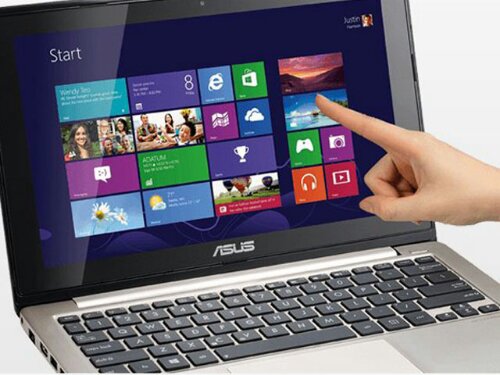
I just placed an order for Asus Vivobook X202E – a small and affordable, touchscreen-enabled Windows 8 mini-laptop. This will be an upgrade to the Samsung N220 netbook I got in March 2010. Windows 8 does not make much sense without touchscreen, and it’s success will be related to how fast people will move to hybrid, touch-enabled paradigm. Working (at home) with the Vivobook should provide opportunity for some experimentation. Its battery is not good enough for serious on-the-road use, but for home it should be ok, we will see…
X202E is not a high-end device, but if you update the touchpad driver and do a few other tweaks, it should be enough for most things. There are good tips in the Amazon.com reviews: http://www.amazon.com/VivoBook-X202E-DH31T-11-6-Inch-Touch-Laptop/product-reviews/B009F1I1C4/
Pervasive Media without Borders
Having spent some time travelling to the other side of the world recently, I have come to think about the role of Internet, content and technology a bit differently than before. The key lesson has been how useless the promises of various media and service ecosystems are, if you cannot access them. You might have bought access to a streaming media service that would be really useful for you and your family while you are away from your friends and family, but you cannot use it, since streaming media is just extremely expensive. Or you might go out and buy a DVD or Blu-ray, but you cannot play it on your device, since it is coming from another “Area” than that of the content you just bought. It is no matter if you try using your iTunes content, something that you could buy from Google Play, or from Microsoft – all those shiny devices and smart services are inherently fragile, dependent on whether there is an open Wi-Fi hotspot somewhere (probably with a 50 megabyte/30 minutes download cap), where you could try to make them run for a moment.
Having to admit that living with unlimited Internet broadband in a well-connected Western country definitely frames this issue as a “First World Problem”, but the lack of a global, pervasive Internet backbone is an issue larger than that. As long as our network technologies are based on high-speed access that is restricted to few urban centres, the true usefulness and radically democratizing potential of Internet and connected services remains limited at best. We need much more ambitious endeavours to get the entire planed connected: this is an issue that can be backed up by commercial, political and even ecological reasons. Establishing solid, reliable links between people living in their villages in the South and the North as well as in the East and the West, can promote local empowerment as well as global collaboration and exchange that is qualitative leap over the current situation.
Satellite data is prohibitively expensive today, but if the initiatives in this area would be given a high enough priority, there is no stopping us having a truly networked world where the global “infosphere” of sharing and communication would be available on equal basis, regardless of the geographical location.
Merry Christmas and Happy New Year to all readers of this blog!
Call for Papers: Physical and Digital in Games and Play seminar
Call for Papers: Physical and Digital in Games and Play seminar
May 29-31, 2013, University of Tampere, FINLAND
Digital games have had a visible role on the contemporary rise of game cultures and game studies, but there are still under-explored research areas in the relation of digital games to other forms of games and play, including e.g. traditional card and board games, play with physical toys, paper-based puzzles, and physical sport games. The research carried out in such areas holds potential for both interesting comparative work in theoretical and empirical game studies, as well as for serving inspiration for experimental design research into hybrid, digital-analogue or augmented game designs.
‘Physical and Digital in Games and Play’ seminar invites presentations from multiple topics related to the unique characteristics of physical play or digital play, as well as to the interplay of these two. The aim of the seminar is to bring together scholars of games and play from diverse fields and to stimulate dialogue between them.
Possible topics include, but are not limited to:
• Theoretical analyses of hybrid games, hybrid toys and hybridity in games
• Case-studies of hybrid play products
• Hybrid experiences in physical and digital play
• Toy design and designer toys
• Board game and table top game design
• Sports and exergames
• Game franchising and IP
• Collectibles cultures
• Cosplay
• Augmented reality games
• Live action role-playing
• History of toys
• Avatar/Body/Doll
• Digital copy vs. physical copy
• Game industry vs. toy industry
• Folk games, folk toys and player created hybridity
• 3D Printing and games
• Games and art, playgrounds and museums, toys and readymade
• Physical and digital in gambling
The seminar is the ninth in the annual series of game studies working paper seminars organised by Game Research Lab at University of Tampere. Due to the work-in-progress emphasis, we strongly encourage submitting late breaking results, working papers and/or submissions from graduate students. Early considerations from projects currently in progress are most welcome, as the purpose of the seminar is to have peer-to-peer discussions and thereby provide support in refining and improving research work in this area. Tentative plans have been made on a publication of selected papers.
The papers to be presented will be chosen based on extended abstract review. Full papers are distributed prior the event to all participants, in order to facilitate discussion.
The two-day event consists of themed sessions that aim to introduce current research projects and discuss ongoing work in studies of games industry, innovation and design processes. The seminar will be chaired by Professor Frans Mäyrä (School of Information Sciences, University of Tampere). There will be invited paper commentators who will be announced later.
The seminar will be held in Tampere, Finland and will be free of charge; the number of participants will be restricted.
Important Dates
* Abstract Deadline: February 25, 2013
* Notification of Acceptance: March 11, 2013
* Full Paper deadline: April 22, 2013
* Seminar dates: May 29-31, 2013
Submission Guidelines
The extended abstract submissions should be between 500-1000 words (excluding references). Abstracts should be sent to <physicaldigitalseminar {at} gmail.com> as plain text only (no attachments). Guidelines for submitting a full seminar paper will be provided with the notification of acceptance.
Our aim is that everyone participating has been able to read materials submitted to the seminar. Therefore, the maximum length for a full paper is set to 6000 words (excluding references). Note also that the presentations held at the seminar should encourage discussion, instead of only repeating the information presented in the papers. Tentatively, every paper will be presented for 10 minutes and discussed for 20 minutes.
Seminar web site: http://physicaldigitalseminar.wordpress.com/
Event page at Facebook: https://www.facebook.com/events/397317950347657/
Organised by: http://gamelab.uta.fi
University of Tampere / SIS, TRIM / Game Research Lab
CFP: Narrative Minds and Virtual Worlds conference, 21-22 May, 2013
Narrative Minds and Virtual Worlds
Tampere, Finland, May 21st and 22nd 2013
Call for Papers
– abstract deadline January 31st, 2013
Keynote speakers:
Marie-Laure Ryan (author of Possible Worlds, Artificial Intelligence and Narrative Theory [1991], Narrative as Virtual Reality [2001] and Avatars of Story [2006]; editor of Cyberspace Textuality [1999] and Narrative across Media [2004])
Jarmila Mildorf (author of Storying Domestic Violence [2007]; editor of Magic, Science, Technology, and Literature [2006] and Imaginary Dialogues in English [2011])
The postclassical turn in narratology has led to 1) a new emphasis on minds, both fictional and interpretative, and 2) the theoretical discovery of storyworlds. These ideas come together in cognitive-theoretically informed narratology, which is well on its way to getting to grips with the processes of immersion and readerly orientation within the storyworld, and also with perceptual positioning on the levels of storyworld, narration and the actual reading process. This conference discusses, applies and tests narratological theories of world and mind construction in different media, ranging from literature to digital games, classroom interaction and corporate communication.
The conference calls for papers from any relevant field of study addressing interfaces of minds and worlds, narrative as well as virtual. Bringing together research on different narrative and quasi-narrative media will reveal both the medium-specific and the transmedial dynamics between inner and outer worlds in narrative sense-making. For instance, the narratological notions of fictional mind construction have lately been informed by theories of spatial and temporal situatedness and its effect on the reading process. The situation of game players immersed in a virtual world involves both interesting similarities with as well as differences to more prototypically narrative environments, particularly in its prioritisation of navigation and problem-solving over empathetic identification. Furthermore, the use of shared storyworlds as foundations for transmedial franchises suggests that worlds may, indeed, be translatable.
This conference is inspired by interdisciplinary and transmedial studies of narrative as pursued by, among others, our keynote speakers Jarmila Mildorf and Marie-Laure Ryan. We welcome papers discussing general and theoretical issues, as well as papers focusing on particular texts or cases in any medium. Furthermore, papers may address medium-specificity or disciplinary boundaries as interpretative or methodological challenges. Possible topics include, but are not limited to
- medial and intermedial construction of minds and worlds in literature and the everyday
- adapting storyworlds from one medium to another
- socially distributed minds in everyday conversation, narration and life stories
- the role of fiction and narration in digital games
- misreading virtual minds in fiction
- fictional worlds in picture books and graphic novels
- virtual worlds and fictional minds as tools for teaching
- game worlds between real action and imaginary spaces
- narrative and ludic agency in game playing
- narrative, material and visual dimensions of organisational sense-making
- “Theories of Mind” in different media
- attributing minds and representing worlds in historical narratives
- exceptional minds and bodies in fiction and the everyday
- dream narratives as virtual worlds
- narrative embodiment in illness narratives
- the function of stories in marketing and brand development
Please send a 250-word abstract to Mari Hatavara (mari.hatavara[at]uta.fi) by January 31st 2013. Be sure to give the title, author(s), affiliation(s), and e-mail address in the same document.
The conference is organised by:
Mari Hatavara, professor of Finnish literature at the University of Tampere School of Language, Translation and Literary Studies
Matti Hyvärinen, professor of Sociology at the University of Tampere School of Social Sciences and Humanities
Frans Mäyrä, professor of Information Studies and Interactive Media at the University of Tampere School of Information Sciences
DiGRA 2013 Call for Papers
This was recently posted to DiGRA’s Gamesnetwork mailing list, please circulate:
The Digital Games Research Association (DiGRA) announces the Call for Participation for DiGRA 2013, to be hosted by Georgia Institute of Technology at the Georgian Terrace Hotel in Atlanta Georgia. DiGRA 2013 will bring together a diverse international community of interdisciplinary researchers engaged in cutting edge research in the field of game studies.
Theme: DeFragging Game Studies
This year’s proposed theme is a playful linguistic remix of the terms “frag” and “defrag.” Defragging is the computer term for reducing file fragmentation. Fragging, derived from the military term for killing a superior officer of one’s own unit, has become video game parlance for the temporary killing of another player.
In the early game studies community, a good deal of fragging (in all three senses) took place between various camps, schools of thought and disciplines. This included discussions as to whether or not game studies should split into more discipline-centered communities; however, the overall trend has been to continue to grow our field as an “interdiscipline” that includes humanities, social sciences and psychology, computer science, design studies, and fine arts. Borrowing from the computer engineering term, the theme for DiGRA 2013 highlights this process of defragmenting, which both embraces and better articulates our diverse methods and perspectives while allowing the game studies research community to remain a coherent and unified whole.
DiGRA 2012 will take place immediately proceeding Dragon*Con, America’s largest multigenre fan convention. For more information, visit: http://www.dragoncon.org/
For more information, visit: http://dm.lmc.gatech.edu/digra2013/ or email digra2013@digra.org
 frans goes blog
You must be logged in to post a comment.