Analog Game Studies

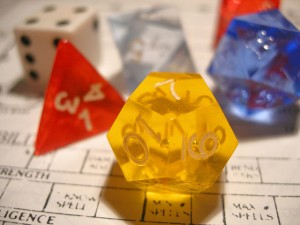
Analog Game Studies (Dice Photo by Dave Ward)

Digital games are not everything there is in games, far from it. There is now a new journal, Analog Game Studies, for all of us interested in board games, table-top role-playing games, card games — I think that actually means most of contemporary game scholars. There has been long-standing discussion that the name of DiGRA should be changed to “GRA” instead (taking “Digital” away from its dominating position of games research), but information technologies sure has been a catalyst for some interesting developments in the field of game cultures, as well as in industry, of course. When there are more dedicated venues of the different forms which games and play are realized in, then we can more clearly see the universals, as well as the particularities, of these specific forms. Link: http://analoggamestudies.org/ .

ToDiGRA: Nordic DiGRA Special Issue

After some technical delays, the special ToDiGRA journal issue based on the Nordic DiGRA 2012 conference best papers is now online. You can find the table of contents below, and the direct link to journal is: http://todigra.org/index.php/todigra/issue/view/2

Transactions of Digital Games Research Association, Vol 1, No 2 (2014)

Special Issue, Selected articles from Nordic DIGRA 2012

Guest editors: Raine Koskimaa, Frans Mäyrä and Jaakko Suominen.

Table of Contents

Special issue, Nordic DIGRA 2012

Introduction: Exploring Nordic Game Research HTML PDF
Raine Koskimaa, Frans Mäyrä, Jaakko Suominen
Digital Materialities and Family Practices: The Gendered, Practical, Aesthetical and Technological Domestication of Play HTML PDF
Jessica Enevold
Player Types: A Meta-synthesis HTML PDF
Juho Hamari, Janne Tuunanen
Player-reported Impediments to Game-based Learning HTML PDF
J. Tuomas Harviainen, Timo Lainema, Eeli Saarinen
A Practical Guide to Using Digital Games as an Experiment Stimulus HTML PDF
Simon Järvelä, Inger Ekman, J. Matias Kivikangas, Niklas Ravaja
Should I stay or should I go? A Study of Pickup Groups in Left 4 Dead 2 HTML PDF
Jonas Linderoth, Staffan Björk, Camilla Olsson
In Defence of a Magic Circle: The Social, Mental and Cultural Boundaries of Play HTML PDF
Jaakko Stenros

Extension: DiGRA 2014 CFP

(Please spread) In an attempt to accommodate requests by DiGRA members, we are extending the Call for Participation. We will be accepting papers, abstracts, panels, and additional submissions, see below, until February 24th.

DiGRA 2014 is being hosted by the University of Utah’s EAE program and will be held in the Wasatch Mountains at Snowbird Ski & Summer Resort from August 3rd-6th. The location is scenic, secluded, economical, and within easy access of Salt Lake City’s International Airport. We believe it offers a unique setting in which to explore games, and the blanks in games research.

To such end the theme of DiGRA 2014 is a phrasal template: <Verb that ends in ‘ing’> the <noun> of Game <plural noun>

For DiGRA’s 2014 Conference we playfully emphasize work that explores non-traditional questions, peers between the cracks of areas that are starting to become well-worn, and revisits old themes from new perspectives. In other words, what has been overlooked or otherwise not given the care and respect it deserves? A Mad Lib is a word game in which one player asks another for nouns, verbs, and other parts of speech with little or no context. They then proceed to fill in the blanks of a phrasal template to often humorous and sometimes profound results. As game scholars we have worked hard to figure out what were the most important blanks. However, at this, the seventh DiGRA conference, we invite you to point out the blanks that have yet to be filled. Your answers to our Mad Lib theme could highlight the profound, sublime, or humorous. We encourage you to trying working the theme into the title of your work.

Conference Website:  http://digra2014.eae.utah.edu/

TRACKS
———-

DiGRA aims at being a venue for game research from all research disciplines. In line with this, it accepts and encourages submissions on a wide range of subjects including but not limited to:

•    Game design: design techniques, practices, methods, post mortems, etc.
•    Game criticism and analysis: close readings, ontologies and frameworks, historical studies, philosophical explorations, and other humanities-informed approaches
•    Play studies: studies of play, observations and interviews of players, and research based on other methods from the social sciences
•    Game technology and production: case studies of experimental game technologies, evaluations of existing systems, and studies of game production processes
•    Applications and uses of games: inquires in serious, documentary games, games for health, gamification, games education, teaching and learning.

Due to the interdisciplinary nature of the DiGRA conference, authors and reviewers alike will be required to describe their research background and field of study. The intention for this is to help reviewers be conscious of when they are reviewing work outside their own field as well as making clear the proportions of contributing fields.

For more information, visit the conference website: http://digra2014.eae.utah.edu/

Formats
———–

Submit a paper or an abstract?

DiGRA 2014 supports two different categories for submitting research; full papers (no more than 16 pages) and abstracts (up to 1000 words including references). The structure reflects the cross-disciplinary nature and different conference traditions of the conference attendants. A full paper submission is recommended for completed research work, in particular empirical or technical work. The abstract format is suitable for discussion topics and ideas. Both papers and abstracts are subject to a double-blind review process, and get equal time for presentation and discussion during the conference.

Accepted full-length submissions will be uploaded into the DiGRA digital library after the conference. Both papers and abstracts will be available from the conference web site, and authors of abstracts may submit a full-length text. Do however note that abstracts, and full-length texts written post conference will not be uploaded to the DiGRA digital library. Finally, both selected articles and full-length texts may be invited for re-publication in the DiGRA journal ToDiGRA.

SUBMISSION DEADLINES
———————————

Submissions site: https://www.easychair.org/conferences/?conf=digra2014

Full papers:
•    No more than 16 pages
•    Will be published on the conference website
•    Will be published in the DiGRA digital library
•    Submission template: here
•    Submission deadline: February 24, 2014
•    Notifications of decisions: March 21, 2014
•    Rebuttal deadline: April 1, 2014
•    Notifications of final decisions: April 15, 2014
•    Revised submission deadline: May 15, 2014 (camera ready)

Abstracts:
•    No more than 1000 words, including references
•    Will be published on the conference website
•    Will not be published in the DiGRA digital library
•    Submission deadline: February 24, 2014
•    Notifications of decision: March 21, 2014
•    Full text submission deadline: May 15, 2014

Panels:
•    Proposal: no more than 1000 words, including references
•    Will not be published in the DiGRA digital library
•    Submission deadline: January 31, 2014
•    Notifications of decision: March 21, 2014
•    Full text submission deadline: May 15, 2014

Workshops:
•    Proposal: no more than 1000 words, including references
•    Indicate full or half day (Workshops will take place August 3, 2014)
•    Contact details of organizing committee
•    Will not be published in the DiGRA digital library
•    Submission deadline: February 24, 2014
•    Notifications of decision: March 21, 2014
•    Full text submission deadline: May 15, 2014

Conference event submissions, filling in the blanks of DiGRA 2014:

DiGRA 2014 understands that no call can accommodate all types of research. We believe that there is excellent research and scholarship happening in the spaces between the formats we traditionally offer. We are happy to consider submissions not listed above, for example tutorials, performances, or an experimental session. Many participants in the past have asked, “why don’t they do a blank” at DiGRA. This is an invitation to fill in the blank.

A conference event proposal can be at most 1000 words long and should provide justification for the event, describe the required time and resources, and provide names and backgrounds of the organisers.

•    Submission deadline: February 24, 2014
•    Notifications of decision: March 1, 2014

Submissions to conference events
For conference events that issue their own calls, deadlines should conform to this schedule.
•    Events Submission deadline: April 15, 2014
•    Events Notification date: May 15, 2014

Program Chairs
———————
•    Staffan Björk, University of Gothenburg, Sweden (staffan.bjork@gu.se)
•    Annika Waern, University of Uppsala, Sweden (annika.waern@im.uu.se)

Conference Chairs
————————-
•    Roger Altizer, University of Utah, USA (roger.altizer@utah.edu)
•    Jose Zagal, University of Utah, USA (jose.zagal@utah.edu)

Program Committee
—————————-
TBA

Venue
——–
Snowbird, Utah – http://www.snowbirdmeetings.com/

CFP: Nordic Digra 2014

lankoski's avatarPetri Lankoski

Games are becoming more and more pervasive in our everyday life. Gamification and game-based learning are research topics that are blooming. Games are also used in electioneering.

We invite submission for full papers and for workshops. Topics of interest include, but are not limited to:

– gamification
– games in society
– games and learning
– games as propaganda
– persuasive games
– games in teaching
– critical stances to gamification and game-based learning

IMPORTANT DATES
– Full paper submission and workshop proposals March 30, 2014
– Notification of acceptance: April 25, 2014
– Camera ready May 18, 2014
– Conference: May 29-30, 2014

SUBMISSIONS

Papers submitted are subject to peer review.

Long papers should be 8 to 12 pages in Digra format (http://todigra.org/public/journals/1/DiGRAJournalPublicationFormat.dotx) . For detailed information see Submission page. Selected papers will be published in conference site as well as at Digital Library of Digital Game…

View original post 42 more words

DiGRA 2013 Proceedings

The proceedings of last year’s “world DiGRA” conference are now online. There are e.g. some work I have collaborated and contributed to:

Mäyrä et al., Disciplinary Identity of Game
Scholars: An Outline:

http://www.digra.org/digital-library/publications/disciplinary-identity-of-game-scholars-an-outline/

Schott et al., DeFragging Regulation: From putative effects
to ‘researched’ accounts of player experience:

http://www.digra.org/digital-library/publications/defragging-regulation-from-putative-effects-to-researched-accounts-of-player-experience/

DiGRA 2014 Call for Papers & Participation

Quick note, spread the word: the CFP for DiGRA 2014 is out at http://digra2014.eae.utah.edu/

ToDiGRA Special Issue CFP: Physical and Digital in Games and Play

Please feel free to spread the word:

ToDiGRA Special Issue CFP: Physical and Digital in Games and Play

Following the successful “Physical and Digital in Games and Play” seminar (May 29-31, 2013, University of Tampere), the Transactions of Digital Games Research Association (ToDiGRA) journal invites paper submissions for a special issue on the role of physicality and materiality in digital games, hybrid media, and mixed reality play experiences. The research carried out in such areas holds potential for providing interesting comparative work in theoretical and empirical game studies as well as inspiring new design experiments of hybrid games, playful media or augmented toys.

While this special issue is seeking articles on hybrid, physical-digital phenomena and their research questions, it is also open to submissions that mostly discuss traditional digital games or physical card, board or outdoor sports games. However, such papers should focus on positioning the role of such phenomena in an increasingly digitally augmented or mediated world.

Possible topics include, but are not limited to:
• Theoretical analyses of hybrid games, hybrid toys and hybridity in games
• Case-studies of hybrid play products
• Hybrid experiences in physical and digital play
• Designs of toy-media or toy-game hybrids
• Digitally augmented board game and table top game designs
• Augmented sports and exergames
• Role-playing with a mixed media component
• Cosplay practices particularly as related to digital games and game characters
• The experience, use, or value of digital copy vs. physical copy
• Game industry vs. toy industry
• Contemporary, mixed media folk games, folk toys, and player created hybridity
• 3D Printing in playful media and games
• Physical games and digital art, playgrounds and museums
• The role of physical and digital in gambling

The editors of this special issue are Professor Frans Mäyrä, University of Tampere; Dr Anu Seisto, VTT; and Dr Katriina Heljakka, Aalto University. The editors bring together a combination perspectives and expertise from digital and mixed reality game research, hybrid media research as well as from art, design and toy research.

The article submissions should be anonymized and follow the DiGRA article template (see http://todigra.org/index.php/todigra/about/submissions). The recommended manuscript length is c. 7000-8000 words. Articles with the appropriate thematic focus for the special issue will be subject to anonymous peer review. The deadline for submissions is 18 October, 2013. Inquiries and submissions (in Word or RTF format) should be emailed to frans.mayra@uta.fi

Transactions of the Digital Games Research Association (ToDIGRA) is an international, open access, refereed, multidisciplinary journal dedicated to research on and practice in all aspects of games. ToDiGRA captures the wide variety of research within the game studies community combining, for example, humane science with sociology, technology with design, and empirics with theory. As such, the journal provides a forum for communication among experts from different disciplines in game studies such as education, computer science, psychology, media and communication studies, design, anthropology, sociology, and business. ToDIGRA is sponsored by the Digital Games Research Association (DiGRA), the leading international professional society for academics and professionals seeking to advance the study and understanding of digital games.

The editorial board of ToDiGRA is: Mia Consalvo, Canada Research Chair in Game Studies and Design, Concordia University; Holin Lin, Professor, National Taiwan University, Department of Sociology; Jesper Juul, Assistant Professor, New York University Game Center; Frans Mäyrä, Professor, University of Tampere, School of Information Sciences; Annika Waern, Professor, Uppsala University, Department of Informatics and Media; José Zagal, Assistant Professor, DePaul University. More of ToDiGRA: http://todigra.org/