
Sanna Malinen’s PhD defence

2016-01-08 14.31.49Today researcher Sanna Malinen defended her PhD thesis in the University of Tampere. The opponent in the public defence was professor Pekka Räsänen from the University of Turku, professor Frans Mäyrä acted as the custos. The abstract and download link to the full, PDF version of the dissertation, titled Sociability and Sense of Community among Users of Online Services, are below:

The dissertation explores a current and popular phenomenon referred to as ‘online communities’ from both theoretical and empirical viewpoints. Online communities are discussed in the context of a wider development in social life from small geography-based units to large and dispersed social networks, which can be mediated by technology. In this study, online communities are understood as fluid objects that are created and maintained through users’ social interactions and actual social practices. Therefore, they are not stable and fixed groups but, instead, a social process that transforms over time.
The empirical portion of this work illustrates the multifaceted nature of the research subject and consists of five case studies exploring the usage of software intended for various purposes: an online photo-sharing service, an online exercise diary, online auctions, and social-media applications for smartphones. In addition, there is a research article consisting of a literature review that synthesise research into online community participation conducted over the past 12 years. The findings from the empirical sub-studies show that community-evocative feelings and behaviors can emerge within various online settings, including dispersed networks and content-oriented sites focusing on artefacts that users produce, such as photographs. However, users can have very different orientations with respect to their interest in social networking and community-building within the context of the same site. The literature review shows that the majority of previous research on user participation has focused on the quantity of their activity. Instead of dividing users into active and passive on the basis of the amount of content they produce, research should acknowledge that there is greater variety in the ways of participating and belonging to an online community.
The dissertation vividly illustrates that online communities are a constantly changing and developing phenomenon. In recent years, the most notable technological changes have been the surge in popularity of large-scale social network sites and increased usage of the Internet via mobile devices. In order for the concept of community to be applied in description of online sociability within current technological settings, the meaning of this term and the criteria for community needs to be rethought.

The full dissertation: http://tampub.uta.fi/handle/10024/98292.
CFP: DiGRA/FDG 2016

Please spread the word:

CFP DiGRA/FDG 2016 – 1st Joint International Conference of DiGRA and FDG

For the first time, the Digital Games Research Association (DiGRA) and the Foundation of Digital Games (FDG) will partner in an unprecedented gathering of games researchers. We invite researchers and educators within game research, broadly construed, to submit their work.

For more information, please visit the conference’s website: www.digra-fdg2016.org

Tracks

DiGRA/FDG aims at being a venue for game research from all research disciplines. In line with this, it accepts and encourages submissions in the following six tracks, on a wide range of subjects including, but not limited to:

  • Game design: Design techniques, practices, methods, post mortems, etc.
  • Game criticism and analysis: Close readings, ontologies and frameworks, historical studies, philosophical explorations, and other humanities-informed approaches
  • Play studies + Interaction and player experience: studies of play, observations and interviews of players, and research based on other methods from the social sciences; game interfaces, player metrics, modeling player experience
  • Artificial intelligence: agents, motion/camera planning, navigation, adaptivity, procedural content generation, dialog, authoring tools, general game playing
  • Game technology: engines, frameworks, graphics, networking, animation
  • Game production: studies of game production processes, studio studies, software studies, platform studies and software engineering

Due to the interdisciplinary nature of the DiGRA/FDG conference, authors and reviewers alike will be required to describe their research background and field of study as part of the submission process. The intention for this is to help reviewers be conscious of when they are reviewing work outside their own field as well as making clear the proportions of contributing fields.

Submission categories

DiGRA/FDG 2016 supports two different categories for submitting research:

  • Full Papers (no more than 16 pages)
  • Extended Abstracts with a maximum length of 2-pages

This structure reflects the cross-disciplinary nature and different conference traditions of the conference attendants. A full paper submission is recommended for completed research work, in particular empirical or technical work. The extended abstract format is suitable for discussion topics and ideas. Both full papers and abstracts are subject to a double-blind review process. These two categories are the only ones that will be published in DiGRA’s digital library.

Deadlines full papers and extended abstracts

Submission deadline

  • January 29 2016 (hard deadline)

Acceptance/rejection notification

  • March 21 2016

Rebuttals

  • March 25 2016

Notification of final decisions

  • March 31 2016

Camera ready

  • April 29 2016

In addition to this, DiGRA/FDG 2016 accepts submissions for:

  • Events with a maximum length of 2-page abstract
  • Panels with a maximum length of 2-page abstract

These are curated by the local organizers and do not go through an anonymized process.

Deadlines panels and events

Submission deadline

  • January 29 2016 (hard deadline)

Acceptance/rejection notification

  • March 21 2016

Camera ready

  • April 29 2016

Some work does not fit as paper presentations due to its nature or research maturity. For this, DiGRA/FDG 2016 is open to submission to the following categories:

  • Posters with a maximum length of 2-page abstract
  • Demos with a maximum length of 2-page abstract

These categories have late deadlines to allow the most recent research and results to be submitted.

Deadlines posters and demos

Submission deadline

  • April 8 2016 (hard deadline)

Acceptance/rejection notification

  • May 9 2016

Camera ready

  • May 23 2016

DiGRA/FDG 2016 provides a doctoral consortium for PhD students. Those interested in attending this should submit a position paper in the extended abstract format with a maximum length of 2 pages.

Deadlines doctoral consortium

Submission deadline

  • April 22 2016 (hard deadline)

Acceptance/rejection notification

  • May 9 2016

DiGRA/FDG 2016 also welcomes submissions to arrange workshops. These have an earlier deadline than other submission to support workshops that wish to have their own peer reviewing process for submissions. These should be submitted as extended abstracts with a maximum length of 2 pages. Please submit workshop proposals by email to the three program chairs, and place “[FDG/DiGRA 2016 Workshop Submission]” in the subject line.

Deadlines workshops

Submission deadlines

  • November 16 2015 (hard deadline)

Acceptance/rejection notification

  • December 11 2015

Location & Date

  • August 1-6 2016
  • The School of Arts, Media and Computer Games, Abertay University
  • Dundee, Scotland, UK

For more information see: www.digra-fdg2016.org

Program Chairs


The Video Game Debate, new book available for (pre)order

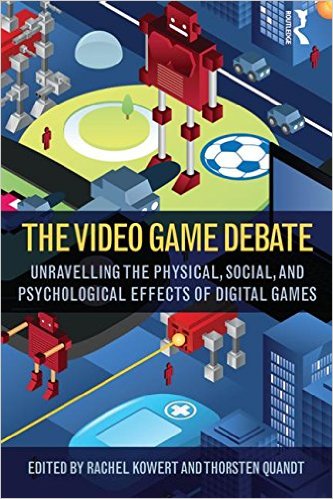
Video Game Debate (book cover)
The Video Game Debate.

New book available for preorder: The Video Game Debate: Unravelling the Physical, Social, and Psychological Effects of Video Games (eds. Rachel Kowert & Thorsten Quandt; publisher: Routledge). Table of contents for this highly interesting, multidisciplinary volume is below:

1. A Brief History of Video Games – James D. Ivory

2. The Rise (and Refinement) of Moral Panic – Nicholas D. Bowman

3. Are Electronic Games Health Hazards or Health Promoters? – Cheryl K. Olson

4. The Influence of Digital Games on Aggression and Violent Crime – Mark Coulson and Christopher J. Ferguson

5. Gaming Addiction and Internet Gaming Disorder – Mark D. Griffiths

6. Social outcomes: Online game play, social currency, and social ability – Rachel Kowert

7. Debating How to Learn From Video Games – John L. Sherry

8. Video Games and Cognitive Performance – Gillian Dale and C. Shawn Green

9. Exploring Gaming Communities – Frans Mäyrä

10. No black and white in video game land! Why we need to move beyond simple explanations in the video game debate – Thorsten Quandt and Rachel Kowert

The publisher’s pages for the book are at: http://www.tandf.net/books/details/9781138831636/

There is also an Amazon.com page for pre-ordering: http://www.amazon.com/The-Video-Game-Debate-Psychological/dp/1138831638 .

Also, the author’s version of my chapter that discusses the study of “gaming communities” is available from here: http://people.uta.fi/~frans.mayra/Gaming_Communities.pdf.

DiGRA 2015

The next major DiGRA conference to take place in European soil will start tomorrow in Lüneburg, Germany. There are several interesting dimensions to this year’s event, including its chosen theme on “Diversity of Play” and the research papers that highlight the multiple phenomena that bound together games, cultures and identities (sometimes in problematic, as well as constructive ways). Myself, I will be e.g. celebrating the original Level Up conference (2003; see the re-opened website), chairing the “From Game Studies to Studies of Play in Society” panel (related to our “Ludification and the Emergence of Playful Culture” research project), and talking about Finnish games and game cultures in the “Video Games Around the World” session (based on a new book of the same title). See you soon in Germany! The conference program is here: http://projects.digital-cultures.net/digra2015/files/2015/05/digra_program_final150504.pdf.

CFP: Farnir 3/2015 (Nordic Issue)

Please spread the word:

CALL FOR PAPERS: Fafnir 3/2015 (Nordic issue)

Fafnir – Nordic Journal of Science Fiction and Fantasy Research invites you to submit a paper for the upcoming edition 3/2015!

Fafnir – Nordic Journal of Science Fiction and Fantasy Research is a peer-reviewed academic journal which is published in electronic format four times a year. Fafnir is published by The Finnish Society of Science Fiction and Fantasy Researchers (Suomen science fiction- ja fantasiatutkimuksen seura ry).

One of the objectives of Fafnir is to join up the Nordic field of science fiction and fantasy research, and the upcoming issue will be dedicated to the history and present state of science fiction and fantasy research in the Nordic countries.

If you would like to submit your text for Fafnir 3/2015, we ask you to take the following into account:

* The main language of the journal is English, but articles are also published in Finnish or in the Scandinavian languages. Please note that if English is not your first language, you should have your text reviewed or edited by an English language editor before submitting it for Fafnir.

* The submissions must be original work.

* Manuscripts of research articles should be between 20,000 and 40,000 characters in length.

* The journal uses the most recent edition of the MLA Style Manual. More information on submission guidelines can be found here: http://journal.finfar.org/for-authors/submission-guidelines.

* The manuscripts of research articles will be peer-reviewed.

In addition to research articles, Fafnir welcomes text submissions such as essays, interviews, overviews and book reviews on any subject suited for the journal.

The deadline for the submissions is 31 May 2015.

Please send your electronic submission (as an RTF-file) to the following address: submissions(at)finfar.org. For further information, please contact the editors: jyrki.korpua(at)oulu.fi, hanna.roine(at)uta.fi and paivi.vaatanen(at)helsinki.fi. More detailed information on our journal is available at http://journal.finfar.org.

The upcoming edition is scheduled for September 2015.

Best regards,

Jyrki Korpua, Hanna-Riikka Roine and Päivi Väätänen

Editors, Fafnir – Nordic Journal of Science Fiction and Fantasy Research

e-mail: submissions(at)finfar.org

http://journal.finfar.org

https://www.facebook.com/groups/fafnirjournal

New research, Games and Culture

Interesting new research papers coming out in Games and Culture, OnlineFirst:

New issue: Fafnir, Nordic Journal of Science Fiction and Fantasy Research

Spreading word, the new issue of Fafnir is out:

Fafnir – Nordic Journal of Science Fiction and Fantasy Research 4/2014

Jyrki Korpua, Hanna-Riikka Roine & Päivi Väätänen:
Editorial 4/2014

Download this article as PDF

_____________________________________________

William Bowman:
Women and Women: Use of Women Types as Rhetorical Techniques in Atwood’s Handmaid’s Tale and Tepper’s Gate to Women’s Country.

Abstract: In this article, I argue both Margaret Atwood in Handmaid’s Tale and Sheri S. Tepper in Gate to Women’s Country use the same three ‘women type’ characters to explore ideal female gender roles and their relationship to society. Further, I argue that both authors use these characters as part of their bigger rhetorical engagement with the American gender essentialist political movements of 1980s. In particular, I argue that Atwood’s types, despite her empathy with the feminist movement, distance her from both radical second-wave separatist feminism and the American religio-political conservative movement of the 80s, and, against Dopp, that Offred does in fact offer an effective ideal female to be emulated in that, by the end of the novel, she defines and externalizes her self. On the other hand, for Tepper I argue, against Pierson, that Gate is not intrinsically anti-sexual but rather anti-romanticism, sexuality—homosexual and otherwise–only the unfortunate collateral damage, and, further, that Tepper’s women types align her much closer to the essentialism of second- and third-wave feminism than Atwood.

Keywords: Atwood, Tepper, Gender Roles, Women, Science Fiction, Handmaid’s Tale, Gate to Women’s Country

Download this article as PDF

Victor Grech, Clare Vassallo and Ivan Callus:
The coldest of all cold monsters: state infliction of infertility.

Abstract:The state may decide to limit its population due to a variety of reasons. This paper reviews the intersection of state-induced infertility in science-fiction, exploring eugenics, overpopulation, along with state-devised strategies to control both overpopulation and the quality of the remaining population.

Keywords:science fiction; infertilty, demodystopias, eugenics.

Download this article as PDF

_____________________________________________

Päivi Väätänen:
Sun Ra: Myth, Science, and Science Fiction.

Download this article as PDF

Jari Käkelä:
Maps for Further Exploring: Experiences from Helsinki Summer School Course “Science Fiction in Literature and Culture”

Download this article as PDF

Jyrki Korpua:
Kirja-arvio: Juri Nummelin & Vesa Sisättö – Tolkien – elämä ja teokset.

Download this article as PDF

ToDiGRA special issue: Physical and Digital in Games and Play

Spreading the word: we have now published the special issue of DiGRA “Transactions” journal (ToDiGRA), on Physical and Digital in Games and Play, many thanks to authors, reviewers and specially to my co-editors Anu Seisto and Katriina Heljakka:

Vol 1, No 3 (2014)

Special issue, chief editor Frans Mäyrä

Table of Contents

Special issue: Physical and Digital in Games and Play

Editors’ Introduction to the Special Issue HTML PDF
Frans Mäyrä, Katriina Heljakka, Anu Seisto
Building Material: Exploring Playfulness of 3D Printers HTML PDF
Stephanie de Smale
Game Design in an Internet of Things HTML PDF
Paul Coulton, Dan Burnett, Adrian Gradinar, David Gullick, Emma Murphy
From the board to the streets: a case study of Local Property Trader HTML PDF
Mark Lochrie
SimCity and the Creative Class: Place, Urban Planning and the Pursuit of Happiness HTML PDF
Frederika A Eilers
“That’s not a secure area”– physical-digital sound links in commercial locative games HTML PDF
Inger Ekman
The Case for Computer-Augmented Games HTML PDF
Karl Bergström, Staffan Björk
The Roll of the Dice in Warhammer 40,000 HTML PDF
Marcus Carter

Link to the journal site: http://todigra.org/index.php/todigra/issue/view/3

Books or Papers?

I was delighted by the recent publication of Jill Walker Rettberg’s book Seeing Ourselves Through Technology: How We Use Selfies, Blogs and Wearable Devices to See and Shape Ourselves. This is partly due to the interesting discussion of phenomena like use of filters in Instagram photos, diaries that write themselves automatically for us, and affective ties to other data, quantified and used to organise and make sense of our “gamified lifes”. But another part stems from the fact that this was a book, a monograph, and also one that was made available under Creative Commons as a digital download.

For us educated in the Humanities, book-lenght studies carry intrinsic value that is hard to explain and measure. Books are works of sustained scholarship, and their hard-copy form is designed for permanence. While I was still actively working in literary and textual studies fields, I was routinely making references to studies in Poetics or Rhetorics, authored originally over two thousand years ago. Making that historical treasure trove to relate and connect with in dialogue with the more recent phenomena from digital culture was a source or enormous thrill and pride. Contemporary papers and articles published only in various, semi-permanent digital archives simply do not fulfill similar function in long-term historical and intellectual perspective.

There has been talk about the “death of the monograph” for several decades already, but somehow the book still survives. The imprints are small, university libraries carry smaller numbers of physical copies, and there are increasing “productivity” and “impact” pressures to publish and read shorter texts online. However, there is also actual research into how a monograph is doing, like “The Role and Future of the Monograph in Arts and Humanities Research” by Peter Williams & co, or Alesia Zuccala’s recent paper on evaluation of Humanities in Research Trends, which point that monographs continue to be essential for Humanities scholarship. The hybrid forms of publishing both a (typically small-print or print-on-demand) hard copy, alongside a searchable and freely available digital version, appear as the most prominent ways towards the future.

Links:
Seeing Ourselves Through Technology: http://www.palgraveconnect.com/pc/doifinder/10.1057/9781137476661

“The role and future of the monograph in arts and humanities research”: http://www.emeraldinsight.com/doi/abs/10.1108/00012530910932294

Research Trends, Issue 32: http://www.researchtrends.com/wp-content/uploads/2013/02/Research_Trends_Issue32.pdf

Keynote on Pervasive Play & Social Media

This Friday I have been invited to present the keynote in the Social Media in Education seminar, organised by TAOKK & TAMK in Tampere. My title is “Mobile and Pervasive Play – the New Potentials for Communication, Information Seeking and Learning” (Mobiili ja kaikkialle levittäytyvä pelillisyys – viestinnän, tiedonhankinnan ja oppimisen uudet mahdollisuudet). You can find the seminar program from here: http://www.tamk.fi/cms/tamk.nsf/($All)/B33A81D7444E0FA7C2257D46001F9A05?OpenDocument .