Dl. 27.1.: haku Internet- ja pelitutkimuksen maisteriopintoihin

Vielä suomenkielinen muistutus tästä internet- ja pelitutkimuksen maisteriopintomahdollisuudesta – ohjelmaan ovat siis tervetulleita hakemaan myös suomalaiset opiskelijat (opintosuorituksia voi tehdä myös suomeksi, vaikka opintokieli onkin kursseilla yleensä englanti). Kotimaisessa maisteriopintojen erillishaussa tälle IGS-linjalle ei voi enää muuten hakea, deadline on tosiaan nyt 27.1. Kiitos jos levitätte tietoa eteenpäin mahdollisesti kiinnostuneille tahoille.

Perustiedot englanniksi:

The application period is now open (until 27 January) for doing the Master’s Degree in Internet and Game Studies in the University of Tampere – if you want to work in your studies with the team of researchers and teachers at UTAgamelab, check out the information below:

Master’s Degree Programme in Internet and Game Studies aims to provide an in-depth view to the fundamental character and development of games and Internet. Games have grown into an important form of culture and human interaction, expanding from entertainment to other areas of life. Internet and social media form an increasingly vital part of communication, social life and distribution of media and services. Degree Programme in Internet and Game Studies is particularly targeted at the questions of analysis, design and application of online services and digital games from user- and culturally focused perspectives. The programme directs students to develop academic skills like critical thinking, scientific writing and carrying out research projects while encouraging active and comprehensive involvement with the practical processes and phenomena related to games and Internet.

The programme is offered by the School of Information Sciences. The school has high profile research groups that are focused on Internet and game studies. There has also been a long history of education in hypermedia and in Information Studies and Interactive Media that forms the basis of this degree programme.

Graduates typically combine the skills and knowledge derived from Degree Programme in Internet and Game Studies with studies and proficiencies that enable them to work as experts of games and Internet in various professional roles, in research, public sector as well as in industry. The need for knowledgeable workforce is growing in the fields related to games and interactive media, but the students should adopt an active attitude in fashioning their own specific area of expertise and professional profile. The possible jobs of graduates include researchers, developers, critics and specialists working with the interpretation, evaluation or implementation of games and social media.

More about admission: http://www.uta.fi/admissions/degreeprog/programmes/igs.html

More about IGS programme: http://www.uta.fi/admissions/degreeprog/programmes/igs.html

Short history of game studies in UTA: http://gameresearchlab.uta.fi/history/

Some featured alumni from IGS and UTAgamelab: http://gameresearchlab.uta.fi/igs-alumni/

Also, feel free to send us mail, if you want further information;

– Frans Mäyrä (frans.mayra at uta.fi / 050 336 7650)

Year in review – my 2015 in game studies

The year 2015 was a busy year, and hard to summarise as it feels like there never really was any time to stop and reflect; thus I welcome this short review note as such opportunity. Much of my time this year was spent on administrative things, related processes, projects, work contracts and plans of restructuring at the multiple levels of the Finnish university system, Tampere 3 university fusion, internal University of Tampere structures, the School of Information Sciences, our degree programmes and the IGS master’s degree programme, TRIM as the research centre and our Game Research Lab, and its individual research projects and other work.

In terms of published research, it was delightful to follow how many interesting book projects were finished and came out during 2015 (many of these are already out and available, even if their official publication year is 2016). Particularly the Routledge Advances in Game Studies series was in high gear, as several important research volumes were published there; my research articles were included in The Dark Side of Game Play, The Video Game Debate and Video Game Policy books. (There were other important books in the series, too, including Rachel Kowert’s Video Games and Social Competence, and Ashley ML Brown’s Sexuality in Role-Playing Games.) For more, see: https://www.routledge.com/series/RAIGS My own work included analysing the subversive uses of chidren’s games, exploring the gaming communities, and (together with Gareth Schott) re-conceptualizing game violence.

In other published work, I was proud to be part of the editorial board of Finnish Yearbook of Game Studies (Pelitutkimuksen vuosikirja; with the new editor-in-chief Raine Koskimaa), have in-depth analyses of our game researcher survey study come out in esteemed Journal of Communication (Thorsten Quandt, Jan Van Looy as the main authors in this article). I also published a historically oriented overview of Finnish games and game culture in the Video Games Around the World volume, edited by the amazingly productive Mark Wolf for the MIT Press. I also wrote an article exploring the character and development of mobile games that was published in the International Encyclopedia of Digital Communication & Society (Wiley-Blackwell). Last but not least, the long-waited book, Playful Identities: The Ludification of Digital Media Cultures came out from Amsterdam University Press. My piece there deals with the culture and identity of casual online play.

Our research team’s work in 2015 again covered a large part of the games, player experiences, design research and game cultures landscapes. Our particular emphasis is on the emerging and transforming aspects of these, multiple and interconnected phenomena and research topics. In 2015 we wrapped up the research projects Hybridex – The User Experience in the Future Playful Hybrid Services and Free2Play – Best Practices for Free-to-Play Game Services. Some of the research publications, including the full final reports from these projects are still coming out, but you can find some of this work at: https://free2playproject.wordpress.com/publications/ and https://hybridex.wordpress.com/ . Our work in the emerging, and newly re-configured borderlines of physical and digital dimensions in play also included also practical design experiments in the TSR funded OASIS research that studied intermixing of work and play, as well as with the playful MurMur chairs (originating from the Hybridex project). Featured in local as well as in international media, such practical implementations of fundamental research particularly appear to attract the attention of wider audiences. The high-quality research on gamification was also getting wider notice this year, including many publications that were coming out from Koukku, Neuroeconomics of Gaming and Free2Play research projects on this theme. Many thanks to all members of our research team, from these, as well as other research projects.

Much of such research that includes direct applications and links with games industry and other end user or interest groups were funded by Tekes, the Finnish Funding Agency for Innovation, as well as by various industry partners. Many thanks to all our collaborating partners, and Tekes in particular for their interest and belief in the significance of games and games related research. The Skene games programme ended in 2015, but everyone very much hopes that the huge funding cuts to Tekes, Academy of Finland and directly to the basic funding of Finnish universities does not stop work in themes that are important for the advancement of fundamental knowledge, cultural richness, and capacity for innovation – be those related to arts, technology, humanities, social sciences or e.g. human well-being (studies of games, play, gamification and playfulness relate and touch upon all those research areas).

Our work continues in active mode also in 2016, thanks to two new Tekes research projects (Hybrid Social Play; STREAM/eSports), the Academy of Finland funded Ludification of Culture and Society project, and other ongoing work that is based on individual research grants that members of our research teams have won, as well as other continuing research projects. There are many important themes that are logical continuation of the earlier work we have done (and I have probably forgot to mention many important achievements above), but there are also new innovations and expansions into new areas that are going on. Directing my time and energy into new research on e.g. hybrid play applications while simultaneously participating in other ongoing work will probably mean that in 2016 there will not be as many publications coming out from myself, but that is part of the natural rhythm, ebb and flow of academic life. It is also important that the new tenure-track associate professor in game culture studies position, announded in summer 2015, will be filled hopefully in early 2016. We are also joining forces among the Finnish game scholars to have more supportive structures and collaborative initiatives to start in 2016.

Again: many thanks for everyone in our team, project collaborators and international friends who have made 2015 such a successful and productive year – wishing you all the best, and hoping to make 2016 also a great year together!

Edit: Oh yes – Jaakko Stenros defending his PhD thesis should of course be mentioned here; every doctoral dissertation from our research team is a major milestone!

Gaming station, next generation

As I wrote around Christmas 2011, I made my latest big PC upgrade then, going for Asus P8Z68-V, GEN3 motherboard and ASUS GTX 560 Ti DirectCU II TOP based system. This served me four, rather than planned five years though. Apparently the motherboard peripherals failed, and then BIOS upgrade went astray, plus botched CMOS reset attempt finally killed the motherboard completely – some nice components were left to my hands, but this system lives no more: https://fransmayra.fi/2011/12/28/the-five-year-upgrade-plan/.

I must say that while setting up your own PC is interesting in itself, the compatibility and driver issues are also bit stressful and tiresome (particularly now, having spent most of last night fighting to revive the old PC system). Thus, this time I decided to submit an order to a store that sells pre-configured, pre-installed and tested PCs that also have the operating system set up. After comparing prices and configurations a bit, I ended up with SystemaStore shop from Oulu. These are some of the highlights of this new gaming station:

Processor: INTEL Core i5-6500 3.2GHz LGA1151 6MB BOXED
Cooler Master HYPER 212 EVO
Motherboad: ASUS Z170-P LGA1151 ATX DDR4 (max. 64GB ram)
Memory: Kingston HyperX Fury 8GB(2x4GB) DDR4 2133Mhz
SSD: Samsung 850 EVO 250GB SSD SATA3
HDD: 1TB 7200RPM SATA3 (Seagate barracuda st1000dm003)
Graphics card: ASUS Strix GeForce GTX 970 OC 4GB (0dB IDLE)
DVD drive: 24X DVD+-RW SATA
Case: Corsair Carbide 200R USB3.0 ATX kotelo
Power source: Corsair 650W 80Plus® Certified ATX (VS650)
Connections: USB2.0/USB3.0/USB type C
OS: Windows 10 64-bit home FI

Let’s see how long it takes before this arrives and I will be able to do the tests (and start working and playing with it – hopefully before my Christmas vacation is over!)

Some product photos:

ASUS-P170-sideways
ASUS Z170-P LGA1151 ATX DDR4

Asus-STRIX-970
ASUS Strix GeForce GTX 970 OC 4GB

Asus-STRIX-970-box
ASUS Strix GeForce GTX 970, box

Cooler-Master-EVO
Cooler Master Hyper 212 EVO

Corsair-200r
Corsair Carbide 200R case

intel_core_i5-6500_32ghz_lga1151_6mb_cache_up_to_360ghz_fc-lga14c_skylake_box-34173680-2
Intel Core i5 processor box

Kingston-Fury
Kingston HyperX Fury DDR memory

Samsung-EVO-SSD
Samsung EVO 250 GB SSD


Corsair VS650 power source
 
More about the motherboard here: https://www.asus.com/fi/Motherboards/Z170-P/

More about the graphics card here: https://www.asus.com/fi/Graphics-Cards/STRIXGTX970DC2OC4GD5/

CFP: CHI PLAY 2016

CHI PLAY 2016

The 3rd ACM SIGCHI Annual Symposium on Computer-Human Interaction in Play
http://chiplay.acm.org
Twitter: #chiplay
Austin, Texas
October 16 – 19, 2016

CHI PLAY is an international and interdisciplinary conference (by ACM SIGCHI) for researchers and professionals across all areas of play, games and human-computer interaction (HCI). We call this area “player-computer interaction.” The goal of the conference is to highlight and foster discussion of current high quality research in games and HCI as foundations for the future of digital play. To this end, the conference will feature streams that blend academic research and games with research papers, interactive demos, and industry case studies. CHI PLAY grew out of the increasing work around games and play emerging from the ACM annual conference on Human Factors in Computing Systems (CHI) as well as smaller conferences such as Fun and Games and Gamification. CHI PLAY is sponsored by the ACM Special Interest Group for Computer-Human Interaction (SIGCHI).

Submission Deadlines:

– April 18, 2016: Full papers
– May 27, 2016: Workshop and course proposals, Student game competition
– July 15, 2016: Doctoral consortium, industry case studies, and works-in-progress

As a SIGCHI-sponsored conference, CHI PLAY will consider submissions related to games and play. We encourage submissions on novel and innovative game interactions and mechanics and acknowledge that contributions on systems research may involve less extensive evaluation than more traditional research papers. We welcome submissions from all topics in interactive game research that are relevant to player-computer interaction, including but not limited to the following:

  • Game Interaction
  • Novel Game Control Novel Implementation Techniques that Affect Player Experience
  • Evaluation of Feedback and Display Technologies for Games
  • Gamification
  • Neurogaming
  • Persuasive Games
  • Games for Health, Learning and Change
  • Exertion Games
  • Player Experience
  • Virtual and Augmented Reality Games
  • Games User Research
  • Game Evaluation Methods
  • Psychology of Players and Games
  • Player Typologies
  • Accessible and Inclusive Game Design
  • Novel Game Mechanics Impacting Player Experience
  • Casual Game Design Studies
  • Social Game Experiences
  • Serious Games
  • Alternate Reality Games
  • Tools for Game Creation
  • Developer Experiences and Studies of Developers
  • Industry Case Studies

Although we are interested in papers on the effects of various technologies, software, or algorithms on player or developer experience, technical contributions without clear indications of the impact on players or developers are not within the scope of CHI PLAY. – See more at: http://chiplay.acm.org/submissions/#sthash.5WF9f5fG.dpuf

CFP: Digital Games Research @ ECREA Conference Prague

Spreading word: Having achieved section status means that games research will have a full presence at the upcoming ECREA conference in Prague from 9 to 12 November 2016 (www.ecrea2016prague.eu).

The Digital Games Research section invites contributions dealing with digital games as cultural objects and digital gaming as a social practice and related topics. Particular interest goes to understanding the cultural, psychological and sociological implications of digital gaming as a pastime and of digital games as cultural objects and mass-market products. Thereby we employ an inclusive definition of digital games as any game played on any digital device and explicitly do not limit the scope for submissions in view of the relative youth of the domain within the field of communication studies and the dynamic nature of the field. Moreover, we welcome contributions dealing with topics traditionally associated with specific subfields such as communication, but also humanities, media psychology, education science, economics and others. Finally, we deliberately aim for both qualitative and quantitative work in the belief that both deserve equal attention and are able to reinforce one another.

Please find the full call for papers here (and below)
http://www.ecrea.eu/news/article/id/261

Conference Call: ECREA’s 6th European Communication Conference ‘Mediated (Dis)Continuities: Contesting Pasts, Presents and Futures’

ECREA and Charles University in Prague welcome the submission of abstracts for presentation at the 6th European Communication Conference to be held in Prague, Czech Republic, from 9 to 12 November 2016.

Jelen-Sanchez, Alenka 01.12.2015
The European Communication Research and Education Association (ECREA), in partnership with Charles University in Prague, will organise the 6th European Communication Conference (ECC). The Conference, due to take place in Prague from 9 to 12 November 2016, has chosen as its overarching theme ‘Mediated (Dis)Continuities: Contesting Pasts, Presents and Futures’.

The organisers call for proposals in all fields of communication and media studies, but particularly invite conceptual, empirical, and methodological proposals on mediated memory cultures and working through discursive dislocations and cultural traumas intrinsic to (late) modernity, that link the general conference theme to the fields pertinent to each ECREA section.

Conference theme: ‘Mediated (Dis)Continuities: Contesting Pasts, Presents and Futures’ 

Discontinuity is the far side of change. Late modernity – as the unstoppable flow of permanent changes – is haunted by the disparity of its various histories, geographies, ontologies and technologies. How are media and communication practices engaged in communicating across these divides?

The theme heralding European Communication Conference 2016 derives from the political history of the post-socialist region of which Prague as the conference host is a symbolic memento. After the collapse of communist totalitarianism, the countries in post-socialist Europe have been undergoing a crisis of continuity in the realms of political values, historical consciousness, moral sense of the self and the memory of the past.

The conference theme, however, reaches far beyond the post-totalitarian context and encourages its participants to reflect upon the question of how media and communication practices are involved in communicating over many other dislocations in political, cultural, temporal or spatial realms in all European countries. Acceleration in all aspects of social life generates pasts we cannot return to, territories we cannot access and selves we do not recognize any more. Are media capable of navigating through the related feelings of nostalgia, cultural trauma, guilt, shame or (be)longing? Does communication help to make sense of them?

Can a sense of home be mediated for those who are expelled from their countries or displaced by war, the paramount discontinuity? How is communication entangled in commemoration and remembering? What are the communicative means of identity building in the age of digitised archives which are not static storehouses of memories? Should we consider the media as an actor in economic discontinuities such as crisis and recession?

We cordially invite media and communication scholars to submit papers addressing these questions – together with other ramifications of the conference theme – and to share their ideas with the wide community of colleagues from Europe and beyond.

Submission and deadline
Proposals for individual papers, panels, and posters can be submitted to one of the 21 ECREA sections through the ECC conference website from 1 December 2015 to 29 February 2016. For section overviews, please click here.

Abstracts should be written in English and contain a clear outline of the argument, the theoretical framework, and, where applicable, methodology and results. The maximum length of individual abstracts is 500 words. Panel proposals, which should consist of five individual contributions, combine a panel rationale with five panel paper abstracts, each of which shall be a maximum length of 500 words.

Participants may submit more than one proposal, but only one paper or poster by the same presenting author will be accepted. Participants can still present in one extra session as second (or third, etc.) author of other papers or posters and can still act as chair or respondent of a panel.. All proposals should be submitted through the conference website from 1 December 2015 to 29 February 2016. Early submission is strongly encouraged. Please note that this submission deadline will not be extended.

Abstracts will be published in a PDF Abstract Book. Full papers (optional) will be published via the conference submission system and available to the registered attendants after logging into the system.

Timeline
Submission of paper and panel abstracts and posters: 29 February 2016
Notification of Acceptance: 30 April 2016
End of Early Bird Registration Fee: 31 August 2016
Presenters’ registration deadline: 1 October 2016
Deadline for submission of the full papers (optional): 15 October 2016

>Visit the 6th European Communication Conference website

Best of both worlds: Windows 10?

2015-12-15 23.40.26
Win10 on Vivobook X202E.

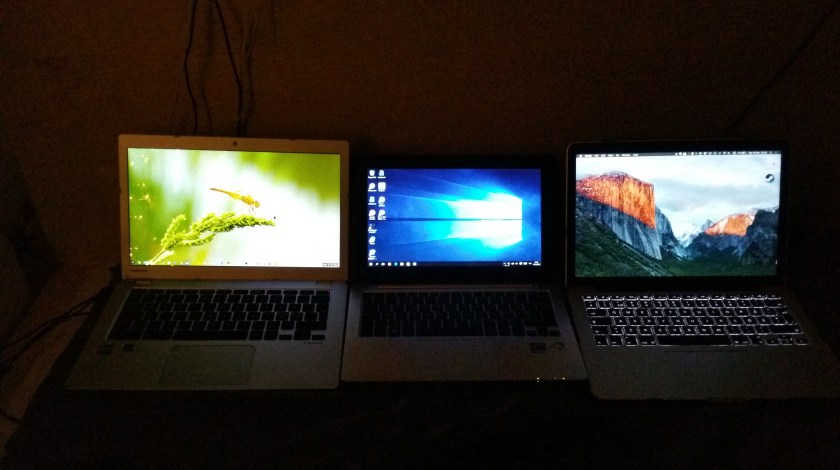
I have been running some small workflow tests on doing basic daily tasks – writing, surfing the web, doing email and project budgets – comparatively on three environments: Chromebook, Windows 10 touchscreen PC, and a Macbook Pro.

While the Mac is the most efficient and beautifully designed of them all (and the retina display is a pleasure to behold), the shallow-move chiclet keyboard does not suit my style of touch-typing. Also, I am still a bit uncomfortable with the way OS X handles maximized apps and keyboard shortcuts to move between them.

2015-12-15 23.23.39
Side by side: Toshiba Chromebook 2, Asus Vivobook X202E (with Win10), and Macbook Pro (with OS X El Capitan).

My Toshiba Chromebook 2 has excellent keyboard, beautiful screen and even the keyboard shortcuts and touchpad controls are simple and clear enough. The problem for a power-user is in the way Chrome OS is often a bit slow to respond, as it needs to load every app and file from the cloud. Also, basic operations such as copy and paste of data between cloud-based apps does not always work, which can be really painful when you are busy working on a deadline.

Windows systems are the basic workhorses of many industry professionals and office workforce in general. I recently updated my old Asus Vivobook X202E into Windows 10, and I have actually been positively surprised how snappy this underpowered, “netbook class” PC can be under the new OS. I also like the flexible, two-handed way of managing the OS and apps simultaneously via both touchscreen, touchpad and keyboard. The trick is to stick to the bare essentials in the software – for example, Chrome is too much work for this old machine to handle these days, but the native Edge browser of Win10 is not (yet) burdened by various extensions and it runs light and fast enough so that I can actually get into the web-based data before my patience runs out. Also, the classic office software and some interesting “modern style” apps work fine in Windows – e.g. this post was written in the new native WordPress desktop app, which can be from found here: https://desktop.wordpress.com/ .

Your mileage may vary, e.g. depending on which cloud service and app ecosystem you are primarily located in. I am a mixed user of iCloud, OneDrive and Dropbox myself (and Android, iOS, PC, Mac, Chrome devices), and while I think that all major OS & service ecosystems have their strengths, I am particularly happy with the Windows 10 style of doing things at the moment. (If only my touchscreen laptop would be a bit more capable and up to date model…)

Applications open: Masters’ Degree in Internet and Game Studies (IGS)

The application period is now open (until 27 January) for doing the Master’s Degree in Internet and Game Studies in the University of Tampere – if you want to work in your studies with the team of researchers and teachers at UTAgamelab, check out the information below:

Master’s Degree Programme in Internet and Game Studies aims to provide an in-depth view to the fundamental character and development of games and Internet. Games have grown into an important form of culture and human interaction, expanding from entertainment to other areas of life. Internet and social media form an increasingly vital part of communication, social life and distribution of media and services. Degree Programme in Internet and Game Studies is particularly targeted at the questions of analysis, design and application of online services and digital games from user- and culturally focused perspectives. The programme directs students to develop academic skills like critical thinking, scientific writing and carrying out research projects while encouraging active and comprehensive involvement with the practical processes and phenomena related to games and Internet.

The programme is offered by the School of Information Sciences. The school has high profile research groups that are focused on Internet and game studies. There has also been a long history of education in hypermedia and in Information Studies and Interactive Media that forms the basis of this degree programme.

Graduates typically combine the skills and knowledge derived from Degree Programme in Internet and Game Studies with studies and proficiencies that enable them to work as experts of games and Internet in various professional roles, in research, public sector as well as in industry. The need for knowledgeable workforce is growing in the fields related to games and interactive media, but the students should adopt an active attitude in fashioning their own specific area of expertise and professional profile. The possible jobs of graduates include researchers, developers, critics and specialists working with the interpretation, evaluation or implementation of games and social media.

More about admission: http://www.uta.fi/admissions/degreeprog/programmes/igs.html

More about IGS programme: http://www.uta.fi/admissions/degreeprog/programmes/igs.html

Short history of game studies in UTA: http://gameresearchlab.uta.fi/history/

Some featured alumni from IGS and UTAgamelab: http://gameresearchlab.uta.fi/igs-alumni/

Also, feel free to send us mail, if you want further information!

Best regards, professor Frans Mäyrä (frans.mayra [at] uta.fi)

Sony RX100: pocket, meet camera

Photography is an interesting thing – many interesting things. Take cameras, for example. For some people, cameras and lenses appear to mean perhaps more than the actual photographs they are supposed to use those equipment for. The global growth of revenue from digital camera industry continues its upwards trend, and by some estimates is expected to reach $46 billion by 2017. There are cameras for multiple uses, and the strengths of one system in one context turn into weaknesses in another. Compare DSLR “systems camera” to a cameraphone (or smartphone), for example: the versatility provided by multiple, interchangeable lenses combined to large image sensor and powerful image processing is unbeatable when the pure technical side of photography as a form of expression is being considered. On the other hand, in everyday daily lives, few people go about hauling their professional DSLR system everywhere. Having a good camera integrated into the mobile phone is your best bet to have camera at hand when the spontaneus opportunity for an interesting photo presents itself. Though, the limitations of small lens and small image sensor inevitably set its limits to what one can achieve with a smartphone camera.

I am going to experiment next by acquiring a compact, “pocket camera” that hopefully would be small enough to actually be feasible to carry around daily in my overcoat pocket, while also having better optics and more versatile feature set than a smartphone camera.

My choice (balancing budget and wish list) concluded into Sony Cyber-shot DSC-RX100 model. This is a compact camera that was introduced already in summer 2012, and there are already several more feature-rich, upgraded versions of RX100 available (Mark II, III, and now also IV, released in summer 2015). My priority here though was to focus on the essential aspects of solid optics combined with decent image sensor and build quality, and the original RX100 ranks high in that department, and the price is pretty competitive by now.

There are few things that smartphone cameras do really well, and extensive app ecosystem, strong computing power in compact form factor and excellent touch screen interfaces are among the key such elements. If the lens and sensor are priority in a compact camera, to get that high quality shot, and you are carrying a powerful smartphone also with you everywhere, it does not make sense to try to duplicate smartphone functions in the camera itself. It is enough to be able to get the photo from camera to the smartphone, and then do the post-processing and possible social media sharing, or archiving from there (or, via a cloud service and/or a PC, for that matter). RX100 does not have a built-in WiFi or other wireless functions, so I have now equipped my new Sony with the Eye-Fi Mobi Pro 32 GB SD memory card, which has the WiFi, and can connect to e.g. iPhone Eye-Fi Mobi app, where from you can take the editing and sharing business as far as you want.

I also invested to some other small add-ons: the official camera LCD screen protector (PCK-LM15) and the Sony AG-R2 Attachment Grip. The latter affects the slim, flat design of RX100 a bit, but is really good for getting reliable hold of the camera so that you can confidently work through multiple positions, without fear of dropping the camera.

RX100 is one of the most popular cameras in the relatively new “enthusiast compact” category, that I guess emerged out of Darwinian adaptation process, where mobile phones took over most of the “snapshot” market, and the compact camera manufacturers were forced to evolve and differentiate their offerings from the most basic and casual photography needs. The manual of RX100 is a rather thick volume, so it has fair number of various options and functions, and this camera has also a rather large, one-inch image sensor (of 20 megapixels), a Carl Zeiss Vario-Sonnar T lens (28-100mm equiv., f/1.8-4.9), image stabilization, automatic face recognition, customizable controls and the ability to shoot recording RAW images – something that the more professional (or nerdy) photo tweakers can value.

It is still too early to say whether the idea of having a daily pocket camera available actually makes any real sense, so that the extra 240 grams of weight in my jacket pocket really pays off. But I guess that in those conference trip breaks this would allow one to jump on and off the “tourist mode” with a bit more expressive range available than just a mobile phone camera would allow. We will see.

CFP: DiGRA/FDG 2016

Please spread the word:

CFP DiGRA/FDG 2016 – 1st Joint International Conference of DiGRA and FDG

For the first time, the Digital Games Research Association (DiGRA) and the Foundation of Digital Games (FDG) will partner in an unprecedented gathering of games researchers. We invite researchers and educators within game research, broadly construed, to submit their work.

For more information, please visit the conference’s website: www.digra-fdg2016.org

Tracks

DiGRA/FDG aims at being a venue for game research from all research disciplines. In line with this, it accepts and encourages submissions in the following six tracks, on a wide range of subjects including, but not limited to:

  • Game design: Design techniques, practices, methods, post mortems, etc.
  • Game criticism and analysis: Close readings, ontologies and frameworks, historical studies, philosophical explorations, and other humanities-informed approaches
  • Play studies + Interaction and player experience: studies of play, observations and interviews of players, and research based on other methods from the social sciences; game interfaces, player metrics, modeling player experience
  • Artificial intelligence: agents, motion/camera planning, navigation, adaptivity, procedural content generation, dialog, authoring tools, general game playing
  • Game technology: engines, frameworks, graphics, networking, animation
  • Game production: studies of game production processes, studio studies, software studies, platform studies and software engineering

Due to the interdisciplinary nature of the DiGRA/FDG conference, authors and reviewers alike will be required to describe their research background and field of study as part of the submission process. The intention for this is to help reviewers be conscious of when they are reviewing work outside their own field as well as making clear the proportions of contributing fields.

Submission categories

DiGRA/FDG 2016 supports two different categories for submitting research:

  • Full Papers (no more than 16 pages)
  • Extended Abstracts with a maximum length of 2-pages

This structure reflects the cross-disciplinary nature and different conference traditions of the conference attendants. A full paper submission is recommended for completed research work, in particular empirical or technical work. The extended abstract format is suitable for discussion topics and ideas. Both full papers and abstracts are subject to a double-blind review process. These two categories are the only ones that will be published in DiGRA’s digital library.

Deadlines full papers and extended abstracts

Submission deadline

  • January 29 2016 (hard deadline)

Acceptance/rejection notification

  • March 21 2016

Rebuttals

  • March 25 2016

Notification of final decisions

  • March 31 2016

Camera ready

  • April 29 2016

In addition to this, DiGRA/FDG 2016 accepts submissions for:

  • Events with a maximum length of 2-page abstract
  • Panels with a maximum length of 2-page abstract

These are curated by the local organizers and do not go through an anonymized process.

Deadlines panels and events

Submission deadline

  • January 29 2016 (hard deadline)

Acceptance/rejection notification

  • March 21 2016

Camera ready

  • April 29 2016

Some work does not fit as paper presentations due to its nature or research maturity. For this, DiGRA/FDG 2016 is open to submission to the following categories:

  • Posters with a maximum length of 2-page abstract
  • Demos with a maximum length of 2-page abstract

These categories have late deadlines to allow the most recent research and results to be submitted.

Deadlines posters and demos

Submission deadline

  • April 8 2016 (hard deadline)

Acceptance/rejection notification

  • May 9 2016

Camera ready

  • May 23 2016

DiGRA/FDG 2016 provides a doctoral consortium for PhD students. Those interested in attending this should submit a position paper in the extended abstract format with a maximum length of 2 pages.

Deadlines doctoral consortium

Submission deadline

  • April 22 2016 (hard deadline)

Acceptance/rejection notification

  • May 9 2016

DiGRA/FDG 2016 also welcomes submissions to arrange workshops. These have an earlier deadline than other submission to support workshops that wish to have their own peer reviewing process for submissions. These should be submitted as extended abstracts with a maximum length of 2 pages. Please submit workshop proposals by email to the three program chairs, and place “[FDG/DiGRA 2016 Workshop Submission]” in the subject line.

Deadlines workshops

Submission deadlines

  • November 16 2015 (hard deadline)

Acceptance/rejection notification

  • December 11 2015

Location & Date

  • August 1-6 2016
  • The School of Arts, Media and Computer Games, Abertay University
  • Dundee, Scotland, UK

For more information see: www.digra-fdg2016.org

Program Chairs


Skene: loppuseminaari

[I will be speaking in the final seminar of Skene r&d-program about the basic research and innovations in games tomorrow in Helsinki] Huomenna on Helsingissä Tekesin pelialan Skene-ohjelman päätösseminaari. Oma alustukseni on otsikoltaan “Pelitutkimus: yhteistyöllä innovaatioita ja tieteen huippuja”. Tapahtumassa on mukana vahva kattaus pelialan osaamista ja toimijoita – tapahtuman ohjelma löytyy täältä: https://www.eventbrite.com/e/tekes-skene-ohjelman-loppuseminaari-registration-18162678059.