Eilisen Vaasa Game Days-seminaarin luentokalvoni ovat nyt saatavilla alta:


anything games, games research related
Eilisen Vaasa Game Days-seminaarin luentokalvoni ovat nyt saatavilla alta:
Huomenna, 24.11. Vaasassa kokoontuu Suomen pelitutkimuksen seura ensimmäiseen syyskokoukseensa (ks. kokouskutsu alla ja Seuran verkkosivut). Vuosikokous kytkeytyy Vaasa Game Days-tapahtumaan, missä itse pidän luennon otsikolla “Pelitutkimuksesta pelillistyvän kulttuurin ja yhteiskunnan tutkimukseen”. Ohjelma: http://www.vaasagamedays.fi/pages/news_display.php?nid=57.
Kokouskutsu: Tervetuloa Suomen pelitutkimuksen seura ry:n syyskokoukseen.

Aika: torstai 24.11.2016 kello 10.00-12.00

Paikka: F223, Fabriikin 2. krs/Viestintätieteet, Vaasan yliopisto
Kokouksessa käsitellään sääntömääräiset asiat ja valitaan toiminnantarkastaja vuosille 2016 ja 2017.

Käsiteltävät asiat:

1. Kokouksen avaus

2. Valitaan kokouksen puheenjohtaja, sihteeri, kaksi pöytäkirjantarkastajaa ja ääntenlaskijaa

3. Todetaan kokouksen laillisuus ja päätösvaltaisuus

4. Hyväksytään kokouksen työjärjestys

5. Vahvistetaan toimintasuunnitelma, tulo- ja menoarvio sekä liittymis- ja jäsenmaksujen suuruudet vuodelle 2017

6. Valitaan hallituksen puheenjohtaja ja muut jäsenet vuodelle 2017

7. Valitaan yksi tai kaksi toiminnantarkastajaa ja varatoiminnantarkastajaa tai yksi tai kaksi tilintarkastajaa ja varatilintarkastajaa vuosille 2016 ja 2017

8. Muut asiat

9. Kokouksen päättäminen
The Full paper and Abstract Proceedings of the 1st International Joint Conference of DiGRA and FDG are now available online in the DiGRA digital library:
Abstract proceedings:
http://www.digra.org/digital-library/forums/13-abstracts-digra-fdg2106/
The full paper proceedings are available here:
http://www.digra.org/digital-library/forums/13-digra-fdg2106/
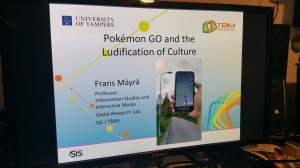
Edit: I published my Mindtrek keynote slides here: http://www.slideshare.net/fransmayra/pokmon-go-and-the-ludification-of-culture – and you can watch an unofficial Periscope recording here: https://twitter.com/pauliinamakela/status/788258441991036928


Apple has been developing their television offerings in multiple fronts: in one sense, much television content and viewers have already moved into Apple (and Google) platforms, as online video and streaming media keeps on growing in popularity. According to one market research report, in 18-24 age group (in America), between 2011 and 2016, traditional television viewing has dropped by almost 40 %. At the same time, subscriptions to streaming video services (like Netflix) are growing. Particularly among the young people, some reports already suggest that they are spending more time watching streaming video as contrasted to watching live television programs. Just in the period from 2012 to 2014, mobile video views increased by 400 %.
Still, the television set remains as the centrepiece of most Western living rooms. Apple TV is designed to adapt games, music, photos and movies from the Apple ecosystem to the big screen. After some problems with the old, second generation Apple TV, I got today the new, 4th generation Apple TV. It has more powerful processor, more memory, a new remote control that has a small touch surface, and runs a new version of tvOS. The most important aspect regarding expansions into new services is the ability to download and install apps and games from thousands that are available in the App Store for tvOS.
After some quick testing, I think that I will prefer using the Remote app in my iPhone 6 Plus, rather than navigating with the small physical remote, which feels a bit finicky. Also, for games the dedicated video game controller (Steelseries Nimbus) would definitely provide a better sense of control. The Nimbus should also play nice with iPhone and iPad games, in addition to Apple TV ones.
Setup of the system was simple enough, and was most easily handled via another Apple device – iCloud was utilized to access Wi-Fi and other registered home settings automatically. Apart from the bit tricky touch controls, the user experience is excellent. Even the default screensavers of the new system are this time high-definition video clips, which are great to behold in themselves. This is not a 4k system, though, so if you have already upgraded the living room television into 4k version, the new Apple TV does not support that. Ours is still a Full HD Sony Bravia, so no problem for us. Compared to some other competing streaming media boxes (like Roku 4, Amazon Fire TV, Nvidia Shield Android TV), the feature set of Apple TV in comparison to its price might seem a bit lacklustre. The entire Apple ecosystem has its own benefits (as well as downsides) though.
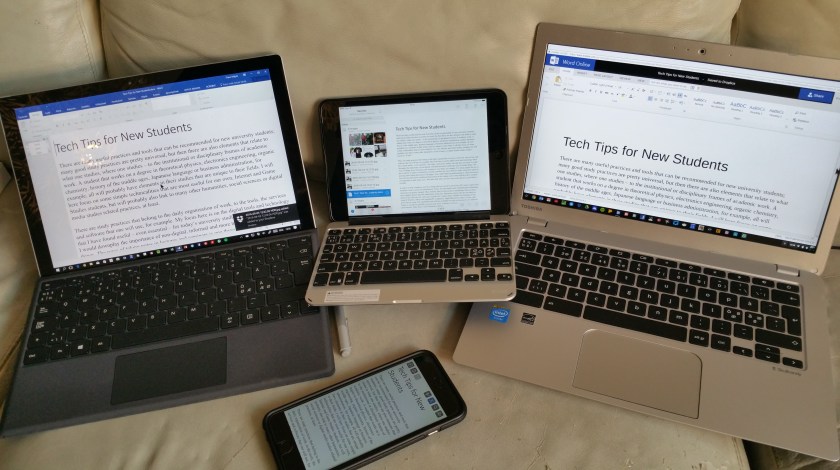
There are many useful practices and tools that can be recommended for new university students; many good study practices are pretty universal, but then there are also elements that relate to what one studies, where one studies – to the institutional or disciplinary frames of academic work. A student that works on a degree in theoretical physics, electronics engineering, organic chemistry, history of the Middle Ages, Japanese language or business administration, for example, all will probably have elements in their studies that are unique to their fields. I will here focus on some simple technicalities should be useful for many students in the humanities, social sciences or digital media studies related fields, as well as for those in our own, Internet and Game Studies degree program.
There are study practices that belong to the daily organisation of work, to the tools, the services and software that one will use, for example. My focus here is on the digital tools and technology that I have found useful – even essential – for today’s university studies, but that does not mean I would downplay the importance of non-digital, informal and more traditional ways of doing things. The ways of taking notes in lectures and seminars is one thing, for example. For many people the use of pen or pencil on paper is absolutely essential, and they are most effective when using their hands in drawing and writing physically to the paper. Also, rather than just participating in online discussion fora, having really good, traditional discussions in the campus café or bar with the fellow students are important in quite many ways. But taken that, there are also some other tools and environments that are worth considering.
It used to be that computers were boxy things that were used in university’s PC classes (apart from terminals, used to access the mainframes). Today, the information and communication technology landscape has greatly changed. Most students carry in their pockets smartphones that are much more capable devices than the mainframes of the past. Also, the operating systems do not matter as much as they did only a few years ago. It used to be a major choice whether one went and joined the camp of Windows (Microsoft-empowered PC computers), that of Apple Macintosh computers, those with Linux, or some other, more obscure camp. The capabilities and software available for each environment were different. Today, it is perfectly possible to access same tools, software or services with all major operating environments. Thus, there is more freedom of choice.
The basic functions most of us in academia probably need daily include reading, writing, communicating/collaborating, research, data collecting, scheduling and other work organisation tasks and use of the related tools. It is an interesting situation that most of these tasks can be achieved already with the mobile device many of us carry with us all the time. A smartphone of iOS or Android kind can be combined with an external Bluetooth keyboard and used for taking notes in the lectures, accessing online reading materials, for using cloud services and most other necessary tasks. In addition, smartphone is of course an effective tool for communication, with its apps for instant messaging, video or voice conferencing. The cameraphone capabilities can be used for taking visual notes, or for scanning one’s physical notes with their mindmaps, drawings and handwriting into digital format. The benefit of that kind of hybrid strategy is it allows taking advantage both of the supreme tactile qualities of physical pen and paper, while also allowing the organisation of scanned materials into digital folders, possibly even in full-text searchable format.
The best tools for this basic task of note taking and organisation are Evernote and MS OneNote. OneNote is the more fully featured one – and more complex – of these two, and allows one to create multiple notebooks, each with several different sections and pages that can include text, images, lists and many other kinds of items. Taking some time to learn how to use OneNote effectively to organise multiple materials is definitely worth it. There are also OneNote plugins for most internet browsers, allowing one to capture materials quickly while surfing various sites.

Evernote is more simple and straightforward tool, and this is perhaps exactly why many prefer it. Saving and searching materials in Evernote is very quick, and it has excellent integration to mobile. OneNote is particularly strong if one invests to Microsoft Surface Pro 4 (or Surface Book), which have a Surface Pen that is a great note taking tool, and allows one to quickly capture materials from a browser window, writing on top of web pages, etc. On the other hand, if one is using an Apple iPhone, iPad or Android phone or tablet, Evernote has characteristics that shine there. On Samsung Note devices with “S Pen” one can take screenshots and make handwritten notes in mostly similar manner than one can do with the MS Surface Pen in the Microsoft environment.
In addition to the note solution, a cloud service is one of the bedrocks of today’s academic world. Some years ago it was perfectly possible to have software or hardware crash and realize that (backups missing), all that important work is now gone. Cloud services have their question marks regarding privacy and security, but for most users the benefits are overwhelming. A tool like Dropbox will silently work in the background and make sure that the most recent versions of all files are always backed up. A file that is in the cloud can also be shared with other users, and some services have expanded into real-time collaboration environments where multiple people can discuss and work together on shared documents. This is especially strong in Google Drive and Google Docs, which includes simplified versions of familiar office tools: text editor, spreadsheet, and presentation programs (cf. classic versions of Microsoft Office: Word, Excel, and PowerPoint; LibreOffice has similar, free, open-source versions). Microsoft cloud service, Office 365 is currently provided for our university’s students and staff as the default environment free of charge, and it includes the OneDrive storage service as well as Outlook email system, and access to both desktop as well as cloud-hosted versions of Office applications – Word Online, Excel Online, PowerPoint Online, and OneNote Online. Apple has their own iCloud system, with Mac office tools (Pages, Numbers, and Keynote) also can be operated in browser, as iCloud versions. All major productivity tools have also iOS and Android mobile app versions of their core functionalities available. It is also possible to save, for example, MS Office documents into the MS OneCloud, or into Dropbox – a seamless synchronization with multiple devices and operating systems is an excellent thing, as it makes possible to start writing on desktop computer, continue with a mobile device, and then finish things up with a laptop computer, for example.
Microsoft Windows, Apple OS X (Macintosh computers) and Linux have a longer history, but I recommend students also having a look at Google’s Chrome OS and Chromebook devices. They are generally cheaper, and provide reliable and very easy to maintain environment that can be used for perhaps 80 % or 90 % of the basic academic tasks. Chromebooks work really well with Google Drive and Google Docs, but principally any service that be accessed as a browser-based, cloud version also works in Chromebooks. It is possible, for example, to create documents in Word or PowerPoint Online, and save them into OneDrive or Dropbox so that they will sync with the other personal computers and mobile devices one might be using. There is a development project at Google to make it possible to run Android mobile applications in Chrome OS devices, which means that the next generation of Chromebooks (which will all most likely support touchscreens) will be even more attractive than today’s versions.
For planning, teamwork, task deadlines and calendar sharing, there are multiple tools available that range from MS Outlook to Google Calendar. I have found that sharing of calendars generally works easier with the Google system, while Outlook allows deeper integration into organisation’s personnel databases etc. It is really good idea to plan and break down all key course work into manageable parts and set milestones (interim deadlines) for them. This can be achieved with careful use of calendars, where one can mark down the hours that are required for personal, as well as teamwork, in addition to lectures, seminars and exercise classes your timetable might include. That way, not all crucial jobs are packed next to the end of term or period deadlines. I personally use a combination of several Google Calendars (the core one synced with the official UTA Outlook calendar) and Wunderlist to-do list app/service. There are also several dedicated project management tools (Asana, Trello, etc.), but mostly you can work the tasks with basic tools like Google Docs, Sheets (Word, Excel) and then break down the tasks and milestones into the calendar you share with your team. Communications are also essential, and apart from email, people today generally utilize Facebook (Messenger, Groups, Pages), Skype, WhatsApp, Google+/Hangouts, Twitter, Instagram and similar social media tools. One of the key skills in this area is to create multiple filter settings or more fine-grained sharing settings (possibly even different accounts and profiles) for professional and private purposes. The intermixing of personal, study related and various commercial dimensions is almost inevitable in these services, which is why some people try to avoid social media altogether. Wisely used, these services can be nevertheless immensely useful in many ways.
All those tools and services require accounts and login details that are easily rather unsafe, by e.g. our tendency to recycle same or very similar passwords. Please do not do that – there will inevitably be a hacking incident or some other issue with some of those services, and that will lead you into trouble in all the others, too. There are various rules-based ways of generating complex passwords for different services, and I recommend using two-factor authentication always when it is available. This is a system where typically a separate mobile app or text messages act as a backup security measure whenever the service is accessed from a new device or location. Life is also much easier using a password manager like LastPass or 1Password, where one only needs to remember the master password – the service will remember the other, complex and automatically generated passwords for you. In several contemporary systems, there are also face recognition (Windows 10 Hello), fingerprint authentication or iris recognition technologies that are designed to provide a further layer of protection at the hardware level. The operating systems are also getting better in protecting against computer viruses, even without a dedicated anti-virus software. There are multiple scams and social engineering hacks in the connected, online world that even the most sophisticated anti-virus tools cannot protect you against.
Finally, a reference database is an important part of any study project. While it is certainly possible to have a physical shoebox full of index cards, filled with quotes, notes and bibliographic details of journal articles, conference papers and book chapters, it is not the most efficient way of doing things. There are comprehensive reference database management services like RefWorks (supported by UTA) and EndNote that are good for this job. I personally like Zotero, which exists both as cloud/browser-based service in Zotero.org, but most importantly allows quick capture of full reference details through browser plugins, and then inserting references in all standard formats into course papers and thesis works, in simple copy-paste style. There can also be set up shared, topics based bibliographic databases, managed by teams in Zotero.org – an example is Zotero version of DigiPlay bibliography (created by Jason Rutter, and converted by Jesper Juul): https://www.zotero.org/groups/digiplay .
As a final note, regardless of the actual tools one uses, it is the systematic and innovative application of those that really sets excellent study practices apart. Even the most cutting edge tools do not automate the research and learning – this is something that needs to be done by yourself, and in your individual style. There are also other solutions, that have not been explored in this short note, that might suit your style. Scrivener, for example, is a more comprehensive “writing studio”, where one can collect snippets of research, order fragments and create structure in more flexible manner than is possible than in e.g. MS Word (even while its Outline View is too underused). The landscape of digital, physical, social and creative opportunities is all the time expanding and changing – if you have suggestions for additions to this topic, please feel free to make those below in the comments.
I am proud to be among the the inaugural group of DiGRA Distinguished Scholars, as recently appointed by the DiGRA executive board:
Ian Bogost
Mia Consalvo
Suzanne DeCastell
Jussi Holopainen
Jesper Juul
Aphra Kerr
Tanya Krzywinska
Jonas Linderoth
Esther MacCallum-Stewart
Frans Mäyrä
Annika Waern
Jose Zagal
There are similar recognitions that established scholarly associations award in their fields, and I am happy to see game studies also now having this kind of instrument for strengthening the community. – Thank you, everyone, the nomination is a great honour!

For those of us who started doing r&d on location-based mobile games decade or two ago, the exploding popularity of Pokémon Go has been exciting, but also perhaps a bit bewildering to follow. There have been many games that have exploited the collaborative, competitive, user-created or spatially based functionalities of augmented reality play in more innovative manner than Pokémon Go, but none of them have managed to grow their player base as fast and into the scale this Niantic’s game has done. Our own research in University of Tampere included work with The Songs of North prototype which our team designed and implemented in the Mogame research project in 2003-2004. Before that, there had been e.g. Botfighters (2001) by the Swedish company It’s Alive, which was neither not yet based on GPS technology, but rather on the use of cell triangulation and SMS messages. It has been interesting to follow how the motif of “city shamans”, teamed up into competing factions and using might and magic to struggle for control of urban areas has developed, varied and re-emerged, starting from our The Songs of North (2003), followed by the Shadow Cities (2010), and then by Ingress (2013), which adopted many of the basic key elements from Shadow Cities. Pokémon Go, in turn, is based on Ingress on its location-based game mechanics.
Some of the comments of pioneering location-based or augmented reality game developers I have read have sounded even a bit irritated that a rather simple and clearly derivative game makes such a breakthrough, supposedly solely on the basis of association with a popular IP (intellectual property). What we witness here is related to the nature of innovation processes, though. Again and again, it is necessarily not the first implementations that become the great success stories; rather, it is the “second penguin” jumping in later, who can learn from the experiences from the pioneers, and implement something that is perhaps not as ambitious, but that is designed and suitable for large-scale, mainstream adoption. The detailed analyses of Pokémon Go will no doubt start appearing soon in game studies conferences and journals, and it is interesting to see how the key elements of its popularity will be described and interpreted. Simplicity is no doubt one such element, but there is more.
The holding power of Pokémon Go is perhaps relatively easy to explain in terms of certain key player motivation theories, plus counting in certain love or nostalgia with the revived transmedial Pokémon phenomena itself – plus certainly some novelty effect from augmented reality, location-based mobile game play, which is still new experience for many people. In player motivations, there are classic achievement motivations, pleasures of accumulating advancement, repetition and variably rewarded effort (a well-known addictive mechanic), that Pokémon games tap into; there is a long series of these games, starting from the 1996 releases of Red and Green games for Game Boy in Japan, continuing through what is now considered seven generations of video games, and also a popular trading card game, plus manga, anime, films, and other related Pokémon branded products. It is often quoted how Satoshi Tajiri, the producer and main creator of the original concept, based Pokémon on his childhood hobby of insect collecting. What is perhaps not so often noted is that Satoshi has also spoken about how exploration into urban wastelands was one of the key inspirations for Pokémon games, and how urban developments according to him had driven away all these fascinating life-forms – Pokémon games were thus designed from the start to mimic exploration into “urban nature” and stimulate the joy of discovery of both common and rare creatures of all kinds, and of learning about their individual characteristics and even potentials for (insect-like) metamorphosis.
Even if the range of Pokémon creatures is large and understanding their characteristics provides plenty of room for learning and improvement, the basic game in Pokémon Go game is so simple that it can be immediately comprehended: move around, catch Pokémon, collect them, power them up, evolve them into new species, and join teams for tournament style battles for the domination of certain key spots (marked as “Gyms” in the game). Thus, Pokémon Go shows key virtues of classic “casual” games: easy to learn, difficult to complete or totally master, leading to near-infinite replay value, or even addictive potential. What remains to be seen, however, is how many of the millions of players will continue to play the game when the novelty effect wears off. The location-based games in the past have remained in the margins, and one of the key reasons is that the extra effort of going out (sometimes also when it is raining, dark, or the surroundings are otherwise not so inviting or even safe) has meant that only the most dedicated parts of “core gamers” audiences have stuck with these games in the past.
In addition to analysing what features Pokémon Go has as a game, it is also interesting to see what features it does not have. Joining teams (blue, red, or yellow) is part of the game, but coordinating or communicating with team members is not part of the game. This is something that happens naturally between people who play in same locations and meet each other, when there is a critical mass of them, and social media also plays an important role for assisting players in this kind of contemporary “pervasive game”. Thus, playing alone in isolated locations, or disconnected from popular media services would inevitably have an effect on the Pokémon Go player experiences. This is a game that is designed for populated, urban areas and there is also heavy reliance on the location data and sites recorded for the earlier Niantic game, Ingress.
The “perfect storm” of Pokémon Go is, in my quick analysis so far thus mainly a combination of two things: the successful simplification of earlier, tested location-based game design features so that they are clear and straightforward enough for mainstream adoption, and secondly, of the critical mass provided by fans of the second-best selling digital game franchise in the world (only Mario games have sold more). There is also the additional boost from its associated, widely familiar “transmedial storyworld” that millions of people who have not played Pokémon video games will also recognize. The threshold for stepping into the shoes of a Pokémon hunter and trainer is low, and pleasures of real-world exploration, rare creature hunting, collecting, points and levels accumulation, competition and collaboration mean that Pokémon Go provides highly accessible and enjoyable combination of real world and gaming fantasy.
I had some movie tickets that were expiring in Sunday, so I went for it, watching in a row three recent movies in cinema. All of these were transmedia storytelling – two of these were movies based on digital games, one was based on a book. I have no time to write actual reviews but a couple of notes:
– Angry Birds Movie: the starting point feels almost like the rumoured Tetris Movie Trilogy – not much narrative material exists in the game to start with, but what little there is, it will be liberally exploited and expanded upon. In this case, we will learn why the birds are angry. In the original games the different birds were colour coded game units that each enabled different slingshot trajectories or other abilities. The movie version does decent work in providing them with personality, and for developing (bit silly and comedy-oriented) backstory for the conflict between the birds and the pigs.
– The BFG (Big Friendly Giant): this is probably the strongest of three, when evaluated in terms of its overall cinematic qualities. The combination of Roald Dahl’s innovative children’s book and Steven Spielberg’s skills in high production value adventure movies provides a balanced mixture of humour, sense of wonder and a touch of some darker themes. The most memorable element is the friendly, 24 feet (over 7 meter) giant himself, played by Mark Rylance, and translated into detailed digital version by advanced motion capture technologies and computer generated imagery. The eyes of this friedly figure are particularly lively, deep and expressive.
– Warcraft: The Beginning: like the title says, this movie is set to the early stages in the history of Azeroth, the main world of Warcraft game series. Gul’dan, an orc warlock, uses fel magic (evil, vampiric style of magic) to open a portal from Draenor, homeworld of orcs (now destroyed by fel magic) to Azeroth, inhabited by humans, elves and dwarves, and a dramatic conflict ensues. The challenge in Warcraft movie appears to be the exact opposite from the Angry Birds one: here, an abundance of characters, plotlines, wars, races, mythical places etc. has to be reduced into something that resembles more or less coherent, classical movie storyline. The reviews have generally been negative, but I actually rather liked the movie – perhaps due to having spent considerable time in Ironforge, Stormwind etc. myself, as a player of Warcraft RTS and World of Warcraft games in the past. The movie does not get very far in itself: there is perhaps ten or more significant characters, some of them are killed, some plots unravelled and others set into motion, and in the end everything just stops, after this prologue having provided hints at important future developments. But landscapes are impressive, some characters relatable, and there is constant “epic tone” in all of it (that might feel ridiculous or appropriate, depending what one’s tastes in genre fantasy are).
All in all, this day of movies just pointed out how central fantasy as an element, impulse and setting has become for popular culture, and how various storyworld elements cross media boundaries with ever-increasing ease.



Using Facebook and Twitter today, like we do these days, liking and sharing and retweeting, it again came to me how complex these basic actions actually, fundamentally are. We click an update to express support, to say “me too”, or just to send a social presence (phatic) style of update: our connection is still working. I am reading what you are saying. In some cases a like or retweet is an endorsement, sometimes not. Sometimes we spread the word because we cannot get our mind around a particular issue or piece of news: could some of you take a look at this, and say if this makes any sense, or not? Many of shared and circulated items are there just for the joke. Tension release and laughing together is important for creating feeling of community.
At the same time, much of these nuances go unnoticed. We just judge the communicative situation, evaluate our social contexts, possibly tweak a bit the distribution range (a closed group, just the closest friends, just the family, all friends, public, etc.) – and then go with the flow. Media is social and our social world is media these days. However, I think it would help to teach, educate and engage more in discussion about “algorithmic literacy”: about our strategies and abilities to read the system that supports, delimits and underlies our media-merged existence today.
This is just a short, late-night note, but I spent a minute trying to find a good primer to contemporary, social media and games related algorithmic literacy, and could not find one. Maybe you can point me to relevant direction? (Blog comments are closed, but my contact details in all leading platforms are readily available.) There are plenty of studies that focus on media literacy, computer literacy, even some on game literacy – but algorithmic literacy focused studies and popular presentations are apparently still harder to come by.
What I mean by everyday algorithmic literacy relates to, for example, how people may strategically follow, like or access social media updates of others, in order to tweak their automated news stream or filter settings: by communicating to the system that I am interested in messages of certain topics, or coming from certain persons, groups or organisations, I am able to influence how my “social graph” develops – until the system logic is again changed, of course. I am not sure how common such “theorycrafting of social media” is these days, but I suspect that pretty much everyone who actively uses these systems instinctively develops some silent knowledge about how their actions produce consequences in their info-sphere, or communicative spaces. Getting that discussion into more self-aware and public ground would be useful. I am sure there are several smart people and teams on social data analysis and information or games literacy fields, at least, who must have much to say on this topic.
 frans goes blog
You must be logged in to post a comment.