Professor of Information Studies and Interactive Media, esp. Digital Culture and Game Studies in the Tampere University, Finland. Occasional photographer and gardener.
I was delighted by the recent publication of Jill Walker Rettberg’s book Seeing Ourselves Through Technology: How We Use Selfies, Blogs and Wearable Devices to See and Shape Ourselves. This is partly due to the interesting discussion of phenomena like use of filters in Instagram photos, diaries that write themselves automatically for us, and affective ties to other data, quantified and used to organise and make sense of our “gamified lifes”. But another part stems from the fact that this was a book, a monograph, and also one that was made available under Creative Commons as a digital download.
For us educated in the Humanities, book-lenght studies carry intrinsic value that is hard to explain and measure. Books are works of sustained scholarship, and their hard-copy form is designed for permanence. While I was still actively working in literary and textual studies fields, I was routinely making references to studies in Poetics or Rhetorics, authored originally over two thousand years ago. Making that historical treasure trove to relate and connect with in dialogue with the more recent phenomena from digital culture was a source or enormous thrill and pride. Contemporary papers and articles published only in various, semi-permanent digital archives simply do not fulfill similar function in long-term historical and intellectual perspective.
There has been talk about the “death of the monograph” for several decades already, but somehow the book still survives. The imprints are small, university libraries carry smaller numbers of physical copies, and there are increasing “productivity” and “impact” pressures to publish and read shorter texts online. However, there is also actual research into how a monograph is doing, like “The Role and Future of the Monograph in Arts and Humanities Research” by Peter Williams & co, or Alesia Zuccala’s recent paper on evaluation of Humanities in Research Trends, which point that monographs continue to be essential for Humanities scholarship. The hybrid forms of publishing both a (typically small-print or print-on-demand) hard copy, alongside a searchable and freely available digital version, appear as the most prominent ways towards the future.
This Friday I have been invited to present the keynote in the Social Media in Education seminar, organised by TAOKK & TAMK in Tampere. My title is “Mobile and Pervasive Play – the New Potentials for Communication, Information Seeking and Learning” (Mobiili ja kaikkialle levittäytyvä pelillisyys – viestinnän, tiedonhankinnan ja oppimisen uudet mahdollisuudet). You can find the seminar program from here: http://www.tamk.fi/cms/tamk.nsf/($All)/B33A81D7444E0FA7C2257D46001F9A05?OpenDocument .
I will be talking today about “Playfulness and the Transformation of Learning” (“Pelillisyys, leikillisyys ja oppimisen muodonmuutos”) in teacher education event in Imatra, Eastern Finland. There will be also an opportunity to provide some demonstrations on the most popular digital game genres, where I also will make use and recommend our (Finnish) introductory online course in games genres and literacy at http://pelitieto.net.
Diversity of play: Games – Cultures – Identities
14-17 May 2015, Lüneburg, Germany www.digra2015.org
Video game culture has had a self-image of being a distinct cultural form united by participants identifying themselves as ‘gamers’ for many years. Variations in this identity have been perceived either in relation to preferred platform or level of commitment and skill (newbie, casual, core, pro, etc.). Today the popularity of games has increased dramatically, games have become more specialized and gaming is taking place in a number of divergent practices, from e-sport to gamification. In addition, the gamer position includes a number of roles and identities such as: players, learners, time-fillers, users, fans, roleplayers, theory crafters, speed runners, etc. Furthermore, techniques like gamification and game-based learning, as well as the playful use of computer simulation for training purposes, is making it difficult to distinguish games from non-games.
Additionally, video game culture is merging with other forms of popular culture and new mobile technologies are making distinctions between digital and non-digital gaming blurred. Yet, whilst the forms of play seem to have become more diverse, the content of games is often only challenged by independent titles. This is the case despite a maturing audience, some of whom now seem to urge for more diverse themes and representations within games. In the light of increasing criticism of the representations and practices that have dominated much of games culture, it seems that the relationship between the identity of the ‘gamer’ and the content of games is undergoing a change.
Traditionally, game studies has tried to find common ground, seeking shared definitions and epistemologies. DiGRA 2015 seeks to encourage questions about the ‘Diversity of play’, with a focus on the multiple different forms, practices and identities labeled as games and/or game culture. The conference aims to address the challenge of studying and documenting games, gaming and gamers, in a time when these categories are becoming so general and/or contested, that they might risk losing all meaning. Given this, what concepts do we need to develop in order for our research to be cumulative and how do we give justice to the diverse forms of play found in different games and game cultures?
As in the previous year, DiGRA 2015 will accept submissions in five categories: full papers, abstracts, panel, workshops, and events. All submissions will be peer-reviewed using double blind reviewing. In addition, all submissions will receive a meta review and authors of rejected full papers will have the possibility to send a rebuttal if they perceive they have been given biased or uninformed reviewers. The conference welcomes submissions on a wide range of topics, including, but not limited to, the following:
Game cultures
Games and intersections with other cultural forms
Online gaming and communication in game worlds
Gender and gaming
Games as representation
Minority groups and gaming
Childhood and gaming
The gaming industry and independent games
Game journalism
Gaming in non-leisure settings
Applications of game studies in other domains
Gamification
System perspectives and mathematical game theory
Hybrid games and non-digital games
Game design characteristics
Technological systems
Simulations
Deadlines
Submission deadlines 22 January (hard deadline)
Acceptance/rejection notification 16 March
Rebuttal deadline 19 March
Camera ready deadline 14 April
Location & Date
14-17 May 2015
Lüneburg, Germany
At Campus of Leuphana University of Lüneburg
Scharnhorststr. 1
D-21335 Lüneburg
For more information and the latest updates regarding the DiGRA 2015 conference, see www.digra2015.org
My new pet theory is that avantouinti (literally “hole-in-the-ice-swimming”) and love of chili peppers are somehow related. At least here in Tampere I can find people who do both: go out in extreme cold, and jump to the lake, and eat extremely hot chilies. It might be that there is need for extra endorphin, if you live up in North, perhaps? Both the pain/taste of chilies and the effects of visiting hot sauna, and submerging in icy water appear to create some kind of mild shock effect to your system, which in turn releases endorphins. Endorphins in turn are natural pharmaceuticals for pain and stress, and seem to interact with the opiate receptors in somewhat similar manner like morphine does.
On the other hand, it might just be a cultural thing: heavy metal music is also popular in the North, and I have also witnessed crowds of black-clothed folks gathering in the annual chili festival in Tampere. For some, it is just that the strong things attract?
As to the health benefits, there are studies that prove both being likely good for us, see e.g. Huttunen, Pirkko; Kokko, Leena; Ylijukuri, Virpi (2004). “Winter swimming improves general well-being”. International Journal of Circumpolar Health63 (2): 140–144. And: Knotkova, H., Pappagallo, M., & Szallasi, A. (2008). Capsaicin (TRPV1 Agonist) Therapy for Pain Relief: Farewell or Revival?The Clinical Journal of Pain, 24(2), 142–154.
Spread the word: We are proud to present the third issue of Fafnir – Nordic Journal of Science Fiction and Fantasy Research! The issue can be read at http://journal.finfar.org.
Fafnir is a new, peer-reviewed academic journal which is published in electronic format four times a year. It is published by The Finnish Society for Science Fiction and Fantasy Research (Suomen science fiction- ja fantasiatutkimuksen seura ry).
The third issue celebrates fantasy. The articles, discussion and reviews in the issue postulate on questions of fantasy literature, fantastic milieus and the imaginative with the discussions on human and humanoid aesthetics in The Chronicles of Narnia, on the subject of the woods as topos in fantastic literature, and on the genre logics of speculative fiction with the example of Finnish weird.
In addition to this, the third issue offers you two literary reviews on recent books by Brian Attebery and Sanna Lehtonen which present new and important insights into fantasy.
Please do remember that Fafnir welcomes submissions of research articles, short overviews, academic book reviews, essays, opinion pieces and the like. More detailed information on the journal and the upcoming issues is available at journal.finfar.org.
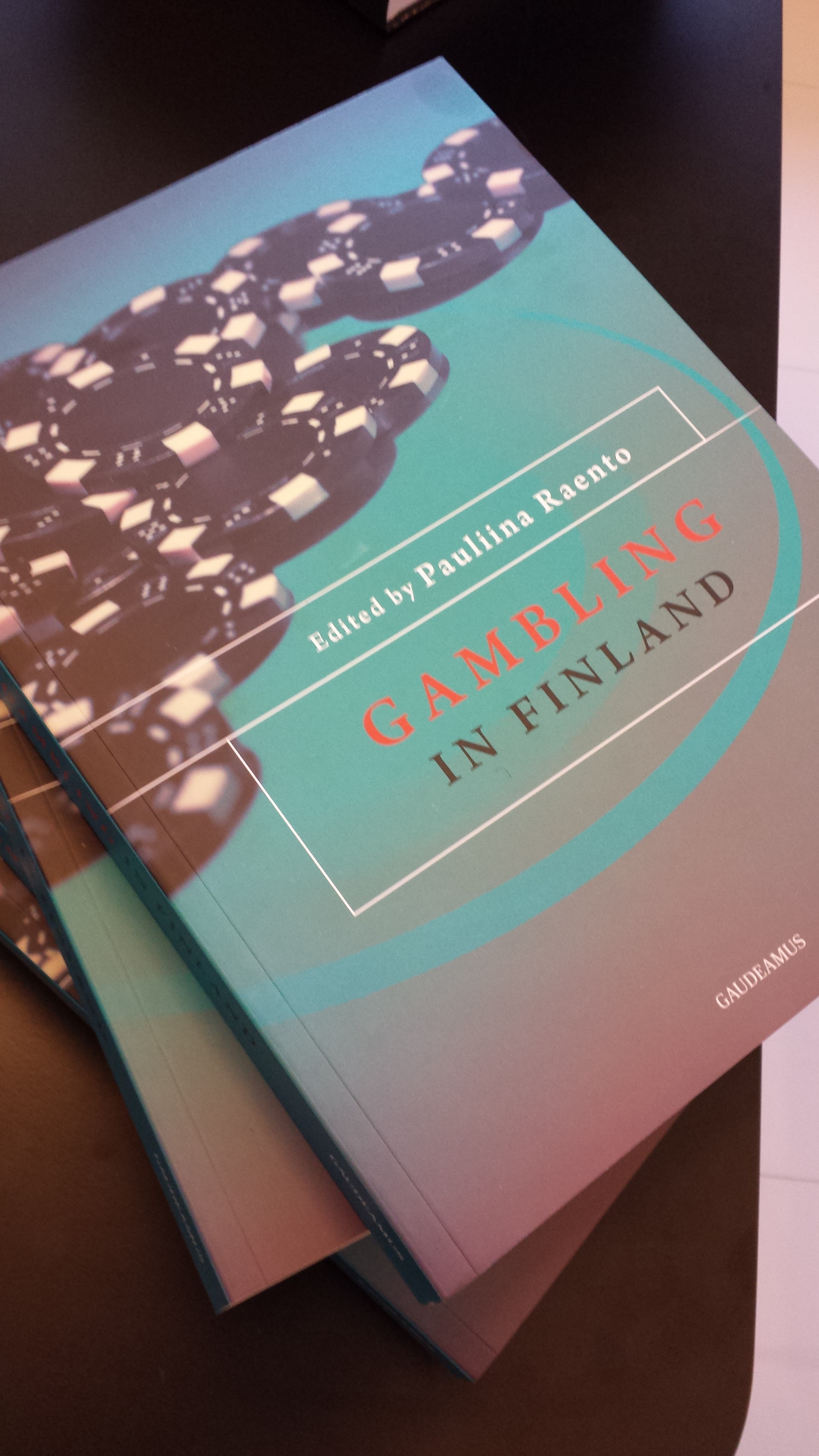
I got my copies of Gambling in Finland: Themes and Data for Qualitative Research (Gaudeamus) today. It is a tightly packed volume of “what” and “how” of gambling studies, showcasing some interesting Finnish research projects and new data sets. Together with Jani Kinnunen, we have a chapter on “Online Gambling and Data” there – you can check more details, including the table of contents from here: http://www.gaudeamus.fi/gambling-in-finland/
Today is the opening of Second Season in OASIS, our experimental play/library/living-room space in School of Information Sciences. There will be bubbly wine and heady ideas available in OASIS today, starting 2 pm – welcome! The invitation is here: http://oasis.uta.fi/season-2-opening-oasis/ Pictured: “There are no rules”, playful work of art by Katariina Heljakka.
[Final seminar of Pelitaito project] Tiedoksi: pelikulttuuria ja pelilukutaitoa edistämään sekä pelihaittoja ennalta ehkäisemään pyrkinyt Pelitaito-projekti toteuttaa hankkeen loppuseminaarin Helsingissä 6.11.2014. Seminaari on maksuton ja paikalle mahtuu 200 ensimmäisenä ilmoittautunutta. Tässä on linkki ilmoittautumissivulle, sekä loppuseminaarin ohjelma:
Good Game – Pelitaito-projektin loppuseminaari
Torstaina 6.11.2014 klo 9-16
Ostrobotnian juhlasali, Museokatu 10, Helsinki
Seminaarin puheenjohtaja, suunnittelija Tommi Tossavainen, Kansallinen audiovisuaalinen instituutti KAVI
9:00–10:00 Aamukahvi ja ilmoittautuminen
10:00–10:10 Seminaarin avaus: Kari Vuorinen, innovaatio- ja talousjohtaja, EHYT ry 10:10–10:35 Pelihaittatyö – sillanrakennusta vai aitojen pystytystä? Saini Mustalampi, kehittämispäällikkö, THL 10.35–10.40 Keskustelu
10:40–11:05 Mitä on pelisivistys? Mikko Meriläinen, projektiasiantuntija, Pelitaito-projekti 11.05–11:10 Keskustelu 11:10–11:30 Kukkahattu eSportsin tarina: Pelitaito-projekti 11:30–12:30 Lounas
12:30–13:00 Voimaantuminen ja pelit – pelifantasian monet maailmat: Frans Mäyrä, professori, Tampereen yliopisto 13:00–13:15 Kommenttipuheenvuoro: Jonne Arjoranta, pelitutkija, Jyväskylän yliopisto
13:15–13:40 Pelien yhteisöllisyys: Marko Siitonen, yliopistonlehtori (FT), Jyväskylän yliopisto 13:40–13:55 Kommenttipuheenvuoro: SEUL ry:n edustaja 13:55–14:00 Keskustelu
14:00–14:30 Kahvi
14:30–15:30 Paneeli: Parempaa pelaamista – miten edistetään pelikasvatusta ja ehkäistään pelihaittoja? Paneelissa mukana: KooPee Hiltunen, johtaja, Neogames ry Jarmo Kumpulainen, strategia- ja edunvalvontajohtaja, RAY Mikko Meriläinen, projektiasiantuntija, Pelitaito-projekti Antti Murto, erikoissuunnittelija, THL Tero Pasanen, pelitutkija, Jyväskylän yliopisto
15:30–16:00 Loppuyhteenveto: pj. Tommi Tossavainen, suunnittelija KAVI Kiitokset: Kari Vuorinen, innovaatio- ja talousjohtaja, EHYT ry
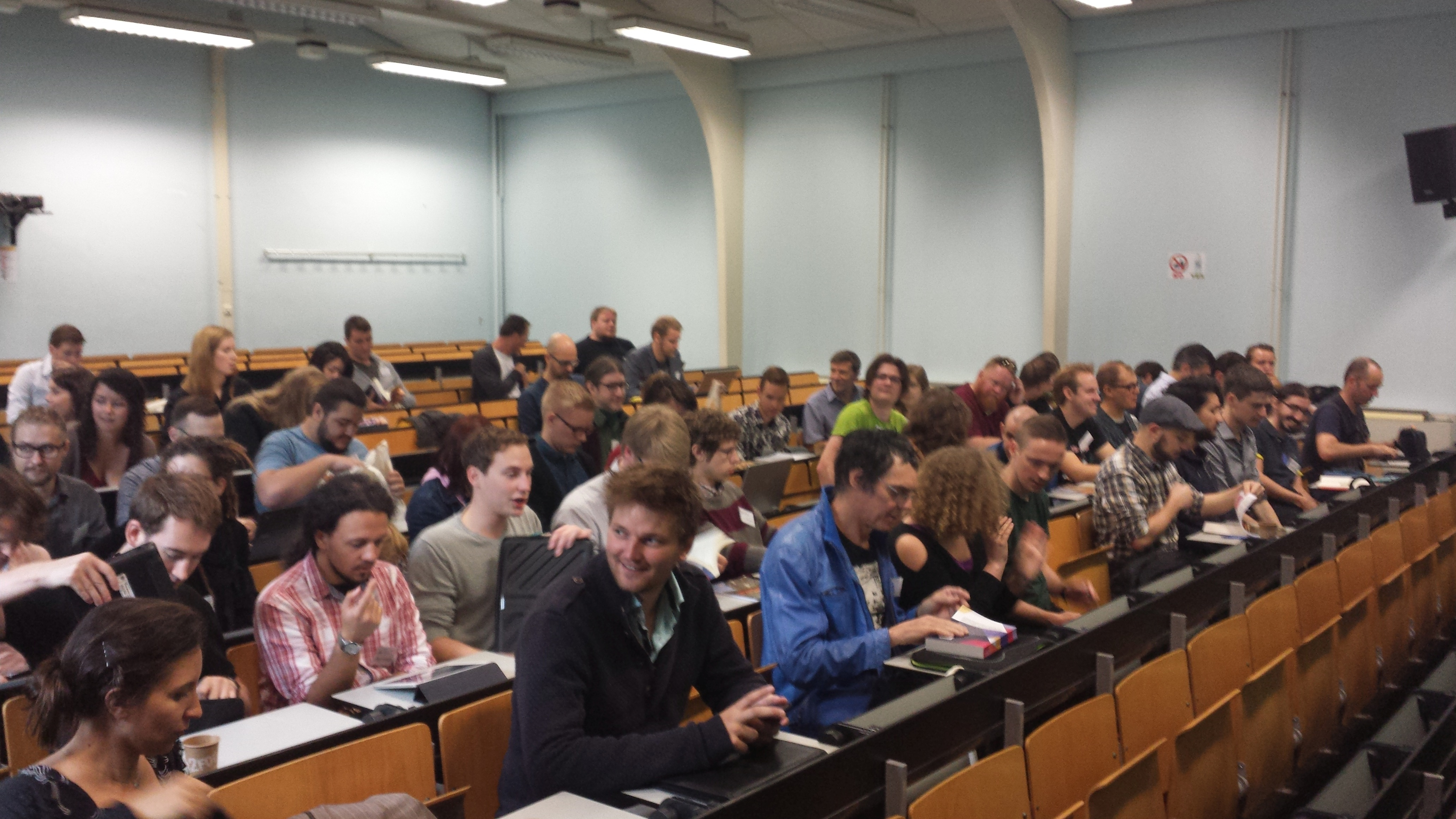
The Summer School of Games and Play Research kicked off in Monday in Utrecht, where a large number of games scholars and students had gathered for two weeks of intensive discussions and presentations. One of the key challenges for setting up this kind of event for this field is related to its aims, and how the Summer School will address the wide reach of different branches of science and scholarship that is somehow related to games and play — should there be, e.g. a course on mathematical Game Theory, or something about current trends in programming in Game Development?
The planning group of the Summer School did its own decisions on how to profile the School, aiming to include those dimensions that relate to humanities, human sciences and design research in particular. Thus, there were sessions for example on the Psychology in Game and Play Research, as well as humanities and design oriented sessions, but Computer Science as well as the Economics, Law, and many other interesting disciplines where games and play are today researched were left off-focus at this time.
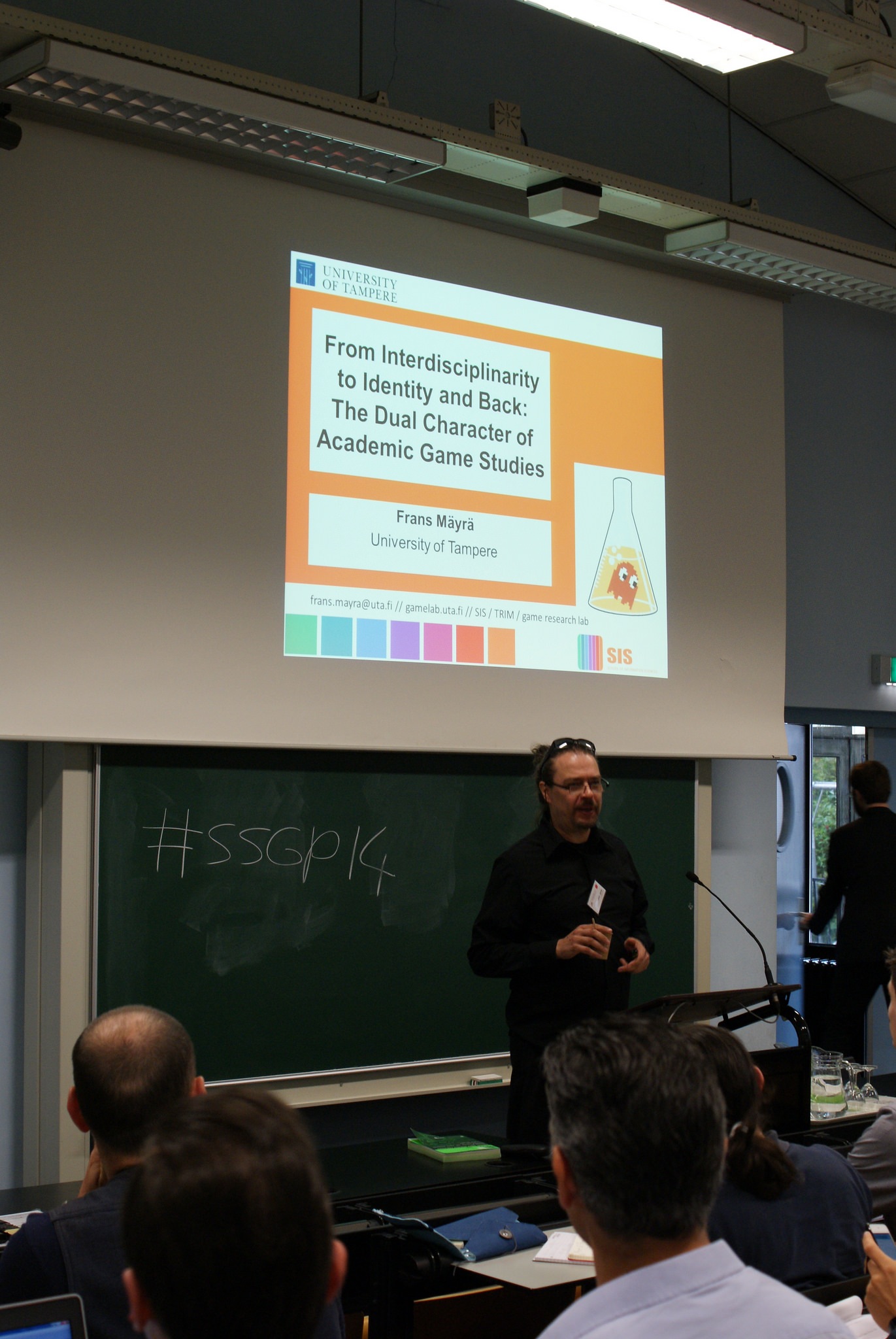
Frans Mäyrä, presenting the Utrecht keynote
In my opening keynote I tried to address the multiplicity of origins, the evolution, and search for identity in Game Studies from multiple angles. As also the data from the games researcher survey I presented proves, this field is highly multi- and interdisciplinary: there are scholars coming from great many different degree programs and disciplinary backgrounds, they collaborate often closely with scholars coming from other fields, and it is also very common to change from one discipline to another. As a field, Game Studies is highly dynamic, and attracts people from all sides of academia. Yet, these people also rather strongly self-identify as a somewhat coherent group: they feel that they are indeed “(digital) games researchers”, and overwhelming majority of respondents of that survey also reported of being “gamers” themselves. (For full details, see: Mäyrä, Frans, Jan Van Looy & Thorsten Quandt (2013) “Disciplinary Identity of Game Scholars: An Outline”. Proceedings of DiGRA 2013. Atlanta: Georgia Tech & DiGRA. [http://www.digra.org/wp-content/uploads/digital-library/paper_146.pdf])
However, to counterbalance the polyphony of different voices and discourses addressing games and play today, also certain disciplinary elements are needed. The academic evaluation, both at the level of individual publications, as well as when job positions are being filled, requires that there are ways to recognise those who are best qualified to comment on the quality of research as Game Studies, and not judge it according to criteria of some other field. This is somewhat tricky thing, of course, and subject of negotiation every time such evaluation work is carried out. Is this something that should be evaluated as humanities oriented Game Studies — or as something with more Social Sciences focus? Is the position filled mainly so that there will be solid conceptual analyst or theorist in the faculty, or for finding someone who can act as a bridge builder between academia and games industry, for example?
I would say that today, like more than a decade ago when the question of disciplinarity of Game Studies was emphatically taken up, there is as much need for “disciplinary work” in the field as ever: there is need for conceptual clarity, continuity and cumulative understanding of key dimensions of games and play research, and also need for standards and reference texts that are necessary milestones in degree programs. However, I would not want to see Game Studies to calcify according any single “dogma” or “right way” of carrying out academic work. And it need not — any disciplinary field with an identity and a living community of scholars is based on constant renegotiation of what “we are”, what this discipline actually is, and what are its key focus areas. It might help to think about organism like amoeba: it has boundaries, it has “inside” and “outside”, but those boundaries are constantly in the move, and adapt to the chancing environment, sometimes engulfin some new element within itself, sometimes possibly even dividing into several new organisms (or: maybe amoeba do not do that? I am more likely thinking of bacteria here…)
There are practical concerns in Game Studies like in any other field in contemporary academia, as the university system is undergoing restructuring and many fields of learning need to provide good reasons for its existence and functions in a society. Game Studies certainly serves important scholarly functions, by addressing phenomena of major significance in the “Ludic Society” of today and tomorrow. The understanding of games, their history, genres, ways of how such dynamic systems operate, their design principles and how they are experienced by different kinds of people — all such things are needed, not only by academic researchers in this field, but also increasingly by experts who want to understand the changes in society, culture, learning, commerce, social interaction, etc. Thus, my claim: “in the future, every discipline needs to be a Game Studies discipline”. On the other hand, it is not enough to have some minor elements related to digital media, online communication and games scattered in several, disconnected degree programs in various parts of academia. There is also need for a “core discipline”, and an increasing (even if still rather modest) need for graduates that can be the experts who provide the reference work and theoretical and practical foundation of games and play research, so that it can then be applied in many other fields as well.
The program of Summer School was built to reflect this kind of principles of multiplicity and unity: the morning keynotes provided coherent arguments and perspectives into what games and play research is, or should be. The afternoons start with disciplinary seminars, where people coming and working within somewhat shared academic frameworks can develop their joint responses and interpretations of those same themes, and to develop their distinctive own agendas. The final element in the program are the more experimental, interdisciplinary workshops and the game jam, designed to bring together people from multiple sides of the research field, and to catalyse new ideas, creative concepts, and processes.
Unfortunately my busy schedules forced me to leave the Summer School early, but I wish everyone very fruitful and stimulating days in Utrecht, and look forward to the results, conclusions and any feedback that will be coming from it. Long live Game Studies – One, and Many!





 frans goes blog
You must be logged in to post a comment.