CFP: DiGRA 2015

Call for papers: DiGRA 2015

Diversity of play: Games – Cultures – Identities
14-17 May 2015, Lüneburg, Germany
www.digra2015.org

Video game culture has had a self-image of being a distinct cultural form united by participants identifying themselves as ‘gamers’ for many years. Variations in this identity have been perceived either in relation to preferred platform or level of commitment and skill (newbie, casual, core, pro, etc.). Today the popularity of games has increased dramatically, games have become more specialized and gaming is taking place in a number of divergent practices, from e-sport to gamification. In addition, the gamer position includes a number of roles and identities such as: players, learners, time-fillers, users, fans, roleplayers, theory crafters, speed runners, etc. Furthermore, techniques like gamification and game-based learning, as well as the playful use of computer simulation for training purposes, is making it difficult to distinguish games from non-games.

Additionally, video game culture is merging with other forms of popular culture and new mobile technologies are making distinctions between digital and non-digital gaming blurred. Yet, whilst the forms of play seem to have become more diverse, the content of games is often only challenged by independent titles. This is the case despite a maturing audience, some of whom now seem to urge for more diverse themes and representations within games. In the light of increasing criticism of the representations and practices that have dominated much of games culture, it seems that the relationship between the identity of the ‘gamer’ and the content of games is undergoing a change.

Traditionally, game studies has tried to find common ground, seeking shared definitions and epistemologies. DiGRA 2015 seeks to encourage questions about the ‘Diversity of play’, with a focus on the multiple different forms, practices and identities labeled as games and/or game culture. The conference aims to address the challenge of studying and documenting games, gaming and gamers, in a time when these categories are becoming so general and/or contested, that they might risk losing all meaning. Given this, what concepts do we need to develop in order for our research to be cumulative and how do we give justice to the diverse forms of play found in different games and game cultures?

As in the previous year, DiGRA 2015 will accept submissions in five categories: full papers, abstracts, panel, workshops, and events. All submissions will be peer-reviewed using double blind reviewing. In addition, all submissions will receive a meta review and authors of rejected full papers will have the possibility to send a rebuttal if they perceive they have been given biased or uninformed reviewers. The conference welcomes submissions on a wide range of topics, including, but not limited to, the following:

  • Game cultures
  • Games and intersections with other cultural forms
  • Online gaming and communication in game worlds
  • Gender and gaming
  • Games as representation
  • Minority groups and gaming
  • Childhood and gaming
  • The gaming industry and independent games
  • Game journalism
  • Gaming in non-leisure settings
  • Applications of game studies in other domains
  • Gamification
  • System perspectives and mathematical game theory
  • Hybrid games and non-digital games
  • Game design characteristics
  • Technological systems
  • Simulations

Deadlines

  • Submission deadlines 22 January (hard deadline)
  • Acceptance/rejection notification 16 March
  • Rebuttal deadline 19 March
  • Camera ready deadline 14 April

Location & Date

14-17 May 2015

Lüneburg, Germany
At Campus of Leuphana University of Lüneburg
Scharnhorststr. 1
D-21335 Lüneburg
For more information and the latest updates regarding the DiGRA 2015 conference, see www.digra2015.org

Program Chairs
Staffan Björk
Jonas Linderoth

OASIS: Season Two

There are no rules (Kati Heljakka)

Today is the opening of Second Season in OASIS, our experimental play/library/living-room space in School of Information Sciences. There will be bubbly wine and heady ideas available in OASIS today, starting 2 pm – welcome! The invitation is here: http://oasis.uta.fi/season-2-opening-oasis/ Pictured: “There are no rules”, playful work of art by Katariina Heljakka.

European Summer School in Games and Play Studies

Next two weeks will be intensive time in Utrecht, the Netherlands, as “Identity and Interdisciplinarity in Games and Play Research”, the joint European Summer School of games and play studies takes place at the Utrecht University. My keynote takes place first in Monday, August 18th, and it is titled “From Interdisciplinarity to Identity and Back: The Dual Character of Academic Game Studies”. More information and full program is available at: http://www.gapsummerschool2014.nl.

Multi.Player 2 conference

Next week there will the Multi.Player 2: Compete, Cooperate, Communicate conference in Münster, Germany. There will be keynotes presented by Richard Bartle, Chris Ferguson, John L. Sherry and myself. The title of my talk is “Mixed Pleasures: Interdisciplinary Perspectives into ‘Social Games'”; you can find more information here: http://www.uni-muenster.de/DigitalGaming/en/Keynote.html#anchor_en_1_7

Game Studies: a polyphonic discipline?

Critical Evaluation of Game Studies: Bart Simon

The Critical Evaluation of Game Studies seminar closed today, leaving a full house of tired but intellectually stimulated games scholars to debate and reflect on the outcomes and overall synthesis of the varied papers and discussions. One of the threads of the discussion concerned the identity and character of Game Studies (or “game studies”, or: games research? Or: ludology, even?) In his keynote, Espen Aarseth talked about Game Studies as a field, and argued (with explicit comment against my earlier published views) that a “discipline” is something that he particularly does not want to see Game Studies developing into.

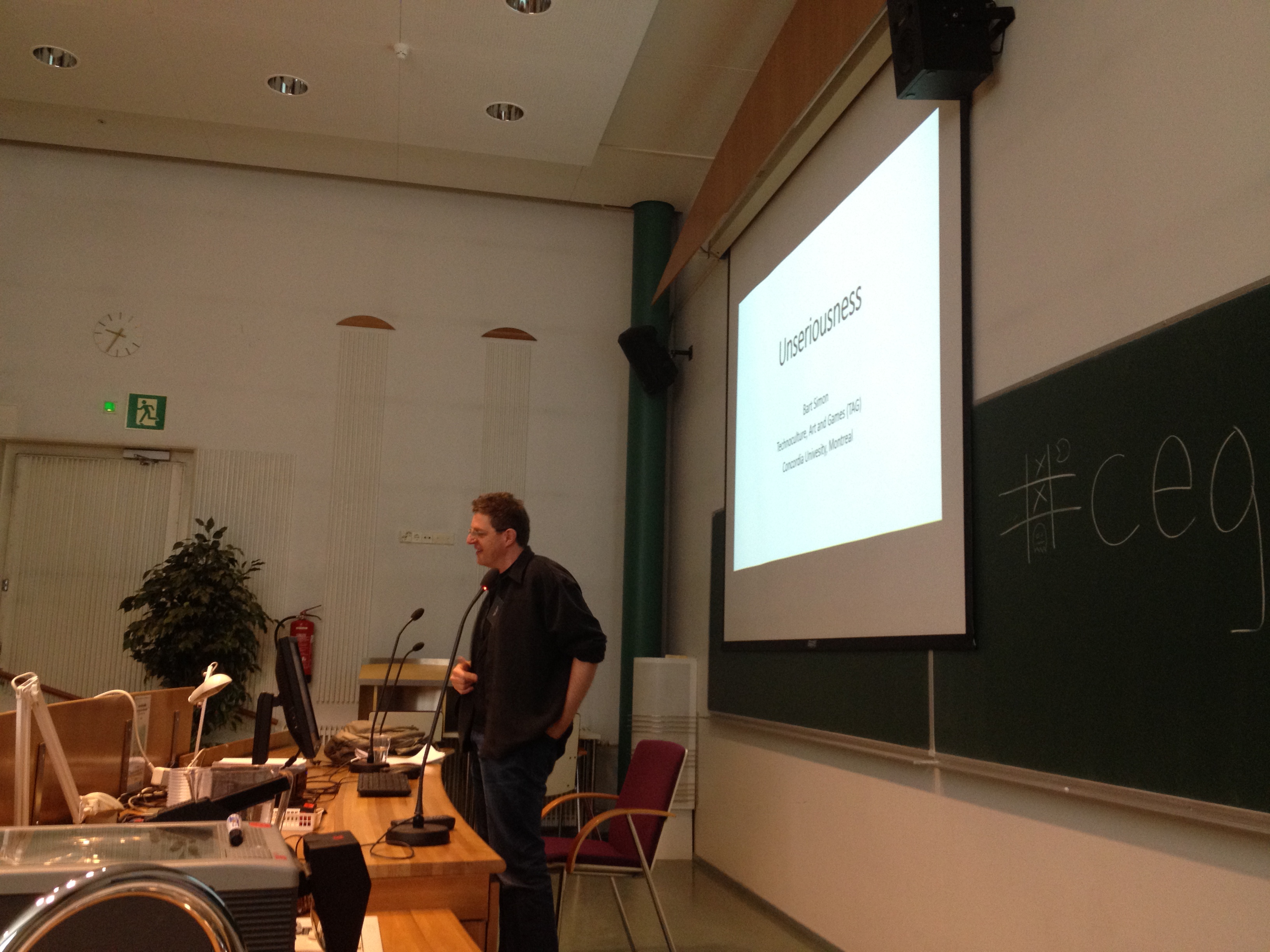
This particular, anti-disciplinary view can in a way be grounded on the existing polyphony in this field: there has not emerged any single, unified school of thought that would encompass everything that is going around games and play in academia. On the other hand, one could also – again following Espen – argue that a discipline that produces its own undergraduates as well as postgraduates would need a more solid methodological basis, and also more established work market to guarantee the employment of such “native graduates”. (Sebastian Deterding had an interesting analysis and proposal in his paper, suggesting that since there are not much guarantees of employment, or not so many well-established publication venues in the “core” areas of Game Studies, people are escaping back to more established academic fields, such as HCI or Communication Studies, which have already opened up for games related research, and provide more institutional work opportunities – and that Game Studies should merge with Design Research so that it would have better opportunities for survival.) Or, one could follow Bart Simon who in his speech talked about the “unseriousness” inherent in games and play as an object of study, and go against the instrumentalization and reification of disciplinary knowledge by principle.

While I see the point of all these, well-grounded arguments, I just want to emphasize again that Game Studies needs both dimensions and movements: both the elements that pull people towards each other and focus at organizing the knowledge production and educational activities in Game Studies into some, hopefully rather unified wholes, as well as more interdisciplinary elements that fertilize and stimulate the growth of new approaches and innovations – both within Game Studies, as well as in other fields of learning. While there is enough anarchist in most game scholars today to make us stand up and go against any attempt at governance or “central control” in this daring, iconoclastic intellectual project that has been set into motion, it is also important, I think, to carry enough responsibility to aim at positive conditions for such project, and sometimes this will also require setting up “disciplinary versions” of the fast-moving research field, so that it can engage with various academic institutions and neighbouring disciplines at even terms. While such “freeze frame” simplifications of the field probably always do some violence to the plurality, coverage and dynamism of Game Studies, they are probably necessary illusions that we also need. Textbooks, lectures and articles are all good places to construct such, identity creating moments of Game Studies, as well as for deconstructing and questioning them. After the seminar, I think that the deconstructionist momentum is currently stronger than the constructivist one, but it just may be my impression.

In any case, I came out of the seminar invigorated and energized, believing even more that before to the need and enormous potential Game Studies has to offer, not only to academia, but also to the surrounding society. If we do not try to fit together and negotiate the multiple aspects that complicate the superficial, commonplace perceptions of what games are, or what game playing means, who is going to do that? Also, I do not think that the other academic disciplines that I know about are that much more unified, or less polyphonic than Game Studies is, actually. As years and decades go past, academics tend to question the truths of their fields from multiple angles, and come up with dozens of different, mutually competing and incompatible theories and approaches into their fields of inquiry. And that is a very good thing. Long live Game Studies, one and many!

Pelaajabarometri 2013: Mobiilipelaamisen nousu

Pelaajabarometri 2013

Pelaajabarometrissa uutta tietoa pelaamisen muutossuunnista

Nyt julkaistu, vuoden 2013 aikana kerättyä aineistoa raportoiva uusin Pelaajabarometri kertoo pelaamisen suosion kokonaisuudessaan pysyneen ennallaan. Jos huomioidaan kaikki erilaiset pelimuodot ja satunnainenkin pelaaminen lähes jokainen suomalainen pelaa ainakin jotakin. Aktiivisia, vähintään kerran kuukaudessa jotain peliä pelaavia suomalaisia on noin 88 prosenttia.

Digitaalisten pelien päätyypeistä älypuhelimilla ja tablet-laitteilla pelattavat mobiilipelit olivat tutkimuksen mukaan merkittävästi kasvattaneet suosiotaan Suomessa. Vuonna 2009 ensimmäisessä Pelaajabarometrissa aktiivisia, vähintään kerran kuussa mobiilipelejä pelaavia vastaajia oli noin 13 %, mutta vuoden 2013 aineistossa tämä osuus jo vajaat 29 %. Käytännössä siis jo lähes joka kolmas suomalainen pelaa vähintään kerran kuussa jotain mobiilipeliä.

Sen sijaan niin tietokonepelit, selaimessa pelattavat pelit (Facebook-pelejä lukuun ottamatta) sekä konsolivideopelit ovat selkeästi menettäneet aktiivisia pelaajia. Esimerkiksi kun yksin pelattavien tietokonepelien aktiivisten pelaajien osuus suomalaisista vuonna 2011 oli yli 40 prosenttia, on se nyt 2013 barometriaineistossa alle 28 prosenttia. Vastaavasti aktiivisten konsolipelaajien osuus on pudonnut kahdessa vuodessa vajaasta 30 prosentista alle 19 prosentin osuuteen tutkittavasta väestöstä. Digitaalisessa pelaamisessa on nähtävissä selvää painopisteen siirtymää konsolivideopeleistä ja tietokonepeleistä tablet-laitteilla ja älypuhelimella pelattavien pelien pariin.

Perinteisten pelimuotojen suosiossa ei ole Pelaajabarometrin mukaan tapahtunut merkittäviä muutoksia, lukuun ottamatta paperilla pelattavia pulmapelejä, jotka ovat menettäneet suosiotaan vuonna 2011 havaitusta vajaasta 48 prosentista vuoden 2013 aineiston vajaaseen 42 prosenttiin aktiivisia pelaajia. Perinteisten rahapelien kohdalla on myös havaittavissa vähenevää suosiota: niin Veikkauksen, RAY:n kuin Fintotonkin järjestämät rahapelit ovat kaikki menettäneet muutaman prosenttiyksikön pelaajasuosiotaan vuoteen 2011 verrattuna. RAY:n perinteisten kolikkoautomaattipelien kohdalla suosion lasku on ollut suurinta. Verkkorahapelit eivät ole vastaavalla tavalla kasvattaneet pelaajamääriään.

Kun kaikkien suomalaisten pelaajien keski-ikä on yli 42 vuotta, on keskimääräinen digitaalisten pelien pelaaja yli 37-vuotias. Miesten ja naisten välisessä pelaamisessa ei kaikki pelaamisen tyypit huomioiden ole merkittävää eroa. Digitaalisen pelaamisen aktiivisuus on kuitenkin miesten ja poikien keskuudessa hieman tyttöjä ja naisia suurempaa.

Kun tarkastellaan yksittäisiä pelejä ja pelisarjoja, nousevat pasianssipelit jälleen ylivoimaisesti suosituimmiksi digitaalisiksi peleiksi. Suomalaisen Rovion Angry Birds -sarjan pelit ovat pelisuosiossa toisella sijalla ja veikkauspelit kolmantena. Suosituimpia pelejä pelataan niin mobiililaitteilla kuin tietokoneillakin.

Barometrissä tutkittiin nyt ensimmäistä kertaa pelien ostamista ja pelien lisäominaisuuksiin kohdistuvaa virtuaalihyödykkeiden ostamista. Digitaalinen jakelu esimerkiksi mobiilipelien verkkokaupoissa (”app stores”) on yleistynyt viime vuosina, mutta nyt toteutettu pelien hankintakysely kertoo että perinteinen, kaupasta tapahtuva pelin ostaminen on edelleen tyypillisin tapa hankkia digitaalinen peli. Kaupasta pelinsä ainakin toisinaan hankki kaikista vastaajista noin 43 prosenttia, aktiivisten digipelaajien joukosta yli puolet.

Lisäksi ilmaispelaaminen (”free-to-play”) ja pelien mikromaksut ovat olleet uudistamassa tuotteista verkkopalveluiksi muuttuvien digitaalisten pelien käytänteitä. Aktiivisista digipelaajista ainakin toisinaan verkkopalvelusta pelejä latasi noin 41 prosenttia, ja ilmaispelien lisäominaisuuksista rahaa oli maksanut 19 prosenttia. Kaikkien vastaajien joukosta vastaavat prosenttiosuudet olivat 27 ja 12 prosenttia. Eri ikäryhmistä aktiivisimpia digitaalisten viihdepelien ostajia olivat 30–39-vuotiaat, aktiiviset digiviihdepelaajat.

Nyt neljättä kertaa toteutettu Pelaajabarometri on kyselytutkimus pelaamisen eri muotojen yleisyydestä Suomessa. Tampereen, Turun ja Jyväskylän yliopistojen pelitutkijoiden yhteistyönä syntynyt tutkimus tarjoaa kattavaa ja ajankohtaista tietoa pelaamisen eri muodoista ja pelaamisen suosioon liittyvistä muutostrendeistä. Vuonna 2013 tutkimukseen kerätty 972 vastaajan aineisto pohjautuu Väestörekisterikeskuksen satunnaisotantaan 10–75–vuotiaista Manner-Suomen asukkaista.

Julkaisun osoite: http://urn.fi/URN:ISBN:978-951-44-9425-3

Lisätietoja:

Professori Frans Mäyrä, frans.mayra@uta.fi, puh. 050 336 7650
Tampereen yliopisto, informaatiotieteiden yksikkö, Game Research Lab
www.uta.fi/sis, http://gamelab.uta.fi


Call for Papers: Fafnir 3/2014

Call for Papers: Fafnir 3/2014

Fafnir – Nordic Journal of Science Fiction and Fantasy Research invites authors to submit papers for the upcoming edition 3/2014.

Fafnir – Nordic Journal of Science Fiction and Fantasy Research is a new, peer-reviewed academic journal which is published in electronic format four times a year. The purpose of Fafnir is to join up the Nordic field of science fiction and fantasy research and to provide a forum for discussion on current issues on the field. Fafnir is published by FINFAR Society (Suomen science fiction- ja fantasiatutkimuksen seura ry).

Now Fafnir invites authors to submit papers for its edition 3/2014. Fafnir publishes various texts ranging from peer-reviewed research articles to short overviews and book reviews in the field of science fiction and fantasy research.

The submissions must be original work, and written in English (or in Finnish or in Scandinavian languages). Manuscripts of research articles should be between 20,000 and 40,000 characters in length. The journal uses the most recent edition of the MLA Style Manual. The manuscripts of research articles will be peer-reviewed. Please note that as Fafnir is designed to be of interest to readers with varying backgrounds, essays and other texts should be as accessibly written as possible. Also, if English is not your first language, please have your article reviewed or edited by an English language editor.

The deadline for submissions is 31 May 2014.

In addition to research articles, Fafnir constantly welcomes text proposals such as essays, interviews, overviews and book reviews on any subject suited for the journal.

Please send your electronic submission (saved as RTF-file) to the following address: submissions(at)finfar.org. For further information, please contact the editors: jyrki.korpua(at)oulu.fi, hanna.roine(at)uta.fi and paivi.vaatanen(at)helsinki.fi.

This edition is scheduled for September 2014. The deadline for the submissions for the next edition is scheduled at 31 August (4/2014).

Best regards,

Jyrki Korpua, Hanna-Riikka Roine and Päivi Väätänen
Editors, Fafnir – Nordic Journal of Science Fiction and Fantasy Research

First issue of Fafnir, science fiction studies journal is out

Spread the word: the first issue of Fafnir – Nordic Journal of Science Fiction and Fantasy Research is now out. Here is the table of contents:

Table of Contents: Fafnir 1/2014

siegfried_kills_fafnir

And Siegfried thought he killed Fafnir. How wrong he was…! (From Wikimedia Commons)

  • Editorial
  • Opposing Forces and Ethical Judgments in Samuel Delany’s Stars in My Pocket like Grains of Sand (Päivi Väätänen)
  • Agents or Pawns? Power Relations in William Gibson’s Bigend Trilogy (Esko Suoranta)
  • What is it that Fanfiction Opposes? The Shared and Communal Features of Firefly/Serenity Fanfiction (Hanna-Riikka Roine)
  • Good and Evil in J.R.R. Tolkien’s Legendarium: Concerning Dichotomy between Visible and Invisible (Jyrki Korpua)
  • Scholars Opposing Forces: Report on FINFAR 2013 Meeting (Katja Kontturi)
  • FINFAR: A Gift from Fandom to Academia (Liisa Rantalaiho)
  • Peeking into the Neighbouring Grove: Speculative Fiction in the Work of Mainstream Scholars (Merja Polvinen)
  • Call for Papers for the 3/2014 issue of Fafnir

The full journal is available at: http://journal.finfar.org/

CFP: Fafnir – Nordic Journal for Science Fiction and Fantasy Research

Please circulate this CFP (I am at the journal advisory board representing game studies related themes):

CALL FOR PAPERS 2/2014

Fafnir – Nordic Journal for Science Fiction and Fantasy Research invites authors to submit papers for the upcoming edition 2/2014.

Fafnir – Nordic Journal for Science Fiction and Fantasy Research is a new, peer-reviewed academic journal which is published in electronic format four times a year. The purpose of Fafnir is to join up the Nordic field of science fiction and fantasy research and to provide a forum for discussion on current issues on the field. Fafnir is published by FINFAR Society (Suomen science fiction- ja fantasiatutkimuksen seura ry).

Now Fafnir invites authors to submit papers for its next edition, 2/2014. Fafnir publishes various texts ranging from peer-reviewed research articles to short overviews and book reviews in the field of science fiction and fantasy research.

The submissions must be original work, and written in English (or in Finnish or in Scandinavian languages). Manuscripts of research articles should be between 20,000 and 40,000 characters in length. The journal uses the most recent edition of the MLA Style Manual. The manuscripts of research articles will be peer-reviewed. Please note that as Fafnir is designed to be of interest to readers with varying backgrounds, essays and other texts should be as accessibly written as possible.

The deadline for submissions is 28 February 2014.

In addition to research articles, Fafnir constantly welcomes text proposals such as essays, interviews, overviews and book reviews on any subject suited to the paper.

Please send your electronic submission (saved as RTF-file) to all three editors at the following addresses: jyrki.korpua@oulu.fi, hanna.roine@uta.fi and paivi.vaatanen@helsinki.fi. For further information, please contact the editors.

This edition is scheduled for June 2014. The deadlines for the submissions for the next two editions are scheduled at 31 May (3/2014) and 31 August (4/2014).

Best regards,

Jyrki Korpua, Hanna-Riikka Roine and Päivi Väätänen
Editors, Fafnir – Nordic Journal for Science Fiction and Fantasy Research

Simulation & Gaming, Finnish Special Issue

Simulation & GamingThere is an interesting bunch of articles now available in the “Online First” area of Simulation & Gaming journal, featuring the work carried out in Finnish simulation, gaming & game studies field (some of it by researchers affiliated with our UTA Game Research Lab), highly worth checking out:

Development of a Finnish Community of Game Scholars
J. Tuomas Harviainen, Timo Lainema, Jaakko Suominen, and Erno Soinila
Simulation & Gaming 1046878113513533, first published on December 3, 2013 as doi:10.1177/1046878113513533
http://sag.sagepub.com/content/early/2013/11/27/1046878113513533.abstract

Hypercontextualized Learning Games: Fantasy, Motivation, and Engagement in Reality
Carolina Islas Sedano, Verona Leendertz, Mikko Vinni, Erkki Sutinen, and Suria Ellis
Simulation Gaming published 30 December 2013, 10.1177/1046878113514807
http://sag.sagepub.com/cgi/content/abstract/1046878113514807v1

Subjective Experience and Sociability in a Collaborative Serious Game
Kimmo Oksanen
Simulation Gaming published 25 December 2013, 10.1177/1046878113513079
http://sag.sagepub.com/cgi/content/abstract/1046878113513079v1

Social Network Games: Players’ Perspectives
Janne Paavilainen, Juho Hamari, Jaakko Stenros, and Jani Kinnunen
Simulation Gaming published 25 December 2013, 10.1177/1046878113514808
http://sag.sagepub.com/cgi/content/abstract/1046878113514808v1

Experience Assessment and Design in the Analysis of Gameplay
Benjamin Cowley, Ilkka Kosunen, Petri Lankoski, J. Matias Kivikangas, Simo Järvelä, Inger Ekman, Jaakko Kemppainen, and Niklas Ravaja
Simulation Gaming published 23 December 2013, 10.1177/1046878113513936
http://sag.sagepub.com/cgi/content/abstract/1046878113513936v1

Formation of Novice Business Students’ Mental Models Through Simulation Gaming
Lauri-Matti Palmunen, Elina Pelto, Anni Paalumäki, and Timo Lainema
Simulation Gaming published 23 December 2013, 10.1177/1046878113513532
http://sag.sagepub.com/cgi/content/abstract/1046878113513532v1

Physiological Linkage of Dyadic Gaming Experience
Simo Järvelä, J. Matias Kivikangas, Jari Kätsyri, and Niklas Ravaja
Simulation & Gaming 1046878113513080, first published on December 23, 2013 as doi:10.1177/1046878113513080
http://sag.sagepub.com/content/early/2013/12/19/1046878113513080.abstract

Table of contents online: http://sag.sagepub.com/content/44/6.toc?etoc