
I will be presenting a keynote in YTP2014 (Yhdistetyt tietojenkäsittelyn päivät / The Federated Computer Science Event of Finland) in Tuesday, 3 June 2014. My talk is titled “The Multidisciplinary Study of Games: An Academic Discipline, or A Research Field without an Identity?” and I will be discussing some of the findings from my earlier, sociology of knowledge style work, as well as touching upon some of the interesting themes discussed in the Critical Evaluation of Game Studies seminar in April. Program link: http://www2.it.lut.fi/ytp2014/ohjelma.
Category: game studies
anything games, games research related
Philosophy of Computer Games 2014 CFP: Freedom in Play
8th International Conference on the Philosophy of Computer Games
Freedom in Play
Istanbul, 13-15 November 2014
2014.gamephilosophy.org
—————————————————————————————-
Abstracts deadline: 15 August 2014
—————————————————————————————-
We hereby invite scholars in any field of studies who take a professional interest in the philosophy of computer games to submit papers to the 8th International Conference on the Philosophy of Computer Games, to be held in Istanbul 13-15 November 2014.
The concept of freedom is central in the shaping of game experiences and game cultures. It is a lens through which we can critically evaluate the philosophical, cultural and political relevance of computer games, as an art form and as a way of life. This year we especially invite papers that address the following areas of philosophical investigation:
1. The nature of freedom in games. Which philosophical concepts can help us clarify ontological and metaphysical dimensions of freedom in games and gaming?
2. The experience of freedom in games. How do we describe and evaluate specific experiences of freedom in play? Are certain types of freedoms in games artistically or ethically more desirable than others? In what way may such evaluations collide when people play together, especially in an on-line context?
3. Games and existential concepts of freedom. In what ways are games capable of expressing truths about the human condition? Is there a way in which they are inherently more or less capable of expressing ethical and normative truths than cinema, photography or art? How do we account for the semantic underpinnings of how games can create this sort of knowledge?
4. Political and ethical freedom. In what way can game mechanics or the social roles of gaming provide normative reasons for decision-making with regard to political freedom, gender issues, etc? Do computer games have a particular potential for being either politically conservative, progressive or subversive?
Accepted papers will have a clear focus on philosophy and philosophical issues in relation to computer games. They will refer to specific examples from computer games rather than merely invoke them in general terms.
In addition to papers that are directed at the main theme we invite a smaller number of papers in an “open” category. We are especially interested in papers that aim to continue discussions from earlier conferences in this series.
The abstracts should have a maximum 1000 words including bibliography. Please note if you intend your paper to fit in the “open” category. The deadline for submissions is Midnight GMT, 15 August, 2014. Please submit your abstract through review.gamephilosophy.org. All submitted abstracts will be subject to double blind peer review. Notification of accepted submissions will be sent out by 15 September 2014. A full paper draft must then be submitted by 6th November 2014 and will be made available on the conference website.
We also invite proposals for panels/workshops on October 12th. Please contact the programme committee chair if you are interested in organising one.
*
Tonguc Ibrahim Sezen, Istanbul Bilgi University (organising committee chair)
Rune Klevjer, University of Bergen (programme committee chair)
Game Studies: a polyphonic discipline?
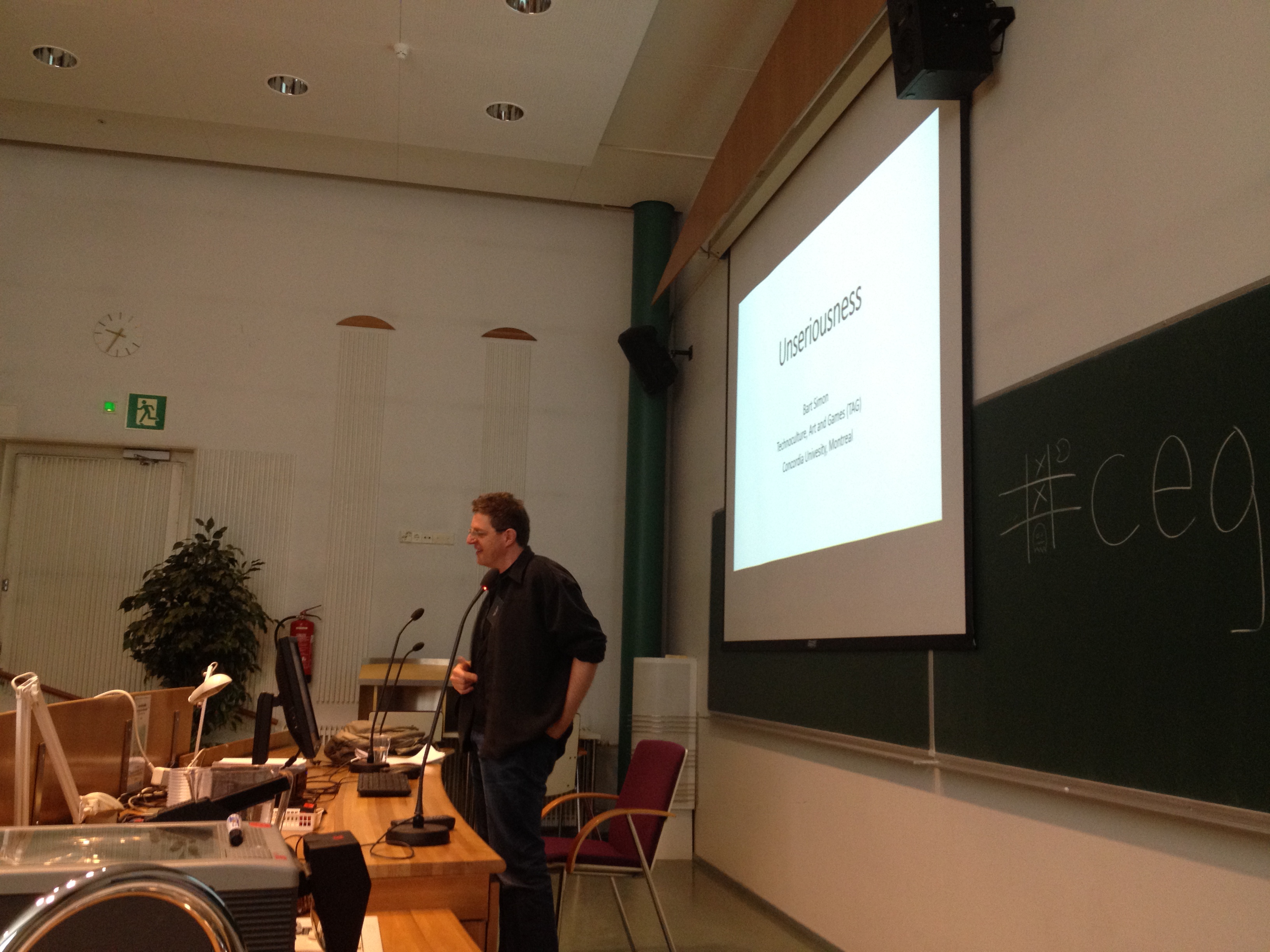
The Critical Evaluation of Game Studies seminar closed today, leaving a full house of tired but intellectually stimulated games scholars to debate and reflect on the outcomes and overall synthesis of the varied papers and discussions. One of the threads of the discussion concerned the identity and character of Game Studies (or “game studies”, or: games research? Or: ludology, even?) In his keynote, Espen Aarseth talked about Game Studies as a field, and argued (with explicit comment against my earlier published views) that a “discipline” is something that he particularly does not want to see Game Studies developing into.
This particular, anti-disciplinary view can in a way be grounded on the existing polyphony in this field: there has not emerged any single, unified school of thought that would encompass everything that is going around games and play in academia. On the other hand, one could also – again following Espen – argue that a discipline that produces its own undergraduates as well as postgraduates would need a more solid methodological basis, and also more established work market to guarantee the employment of such “native graduates”. (Sebastian Deterding had an interesting analysis and proposal in his paper, suggesting that since there are not much guarantees of employment, or not so many well-established publication venues in the “core” areas of Game Studies, people are escaping back to more established academic fields, such as HCI or Communication Studies, which have already opened up for games related research, and provide more institutional work opportunities – and that Game Studies should merge with Design Research so that it would have better opportunities for survival.) Or, one could follow Bart Simon who in his speech talked about the “unseriousness” inherent in games and play as an object of study, and go against the instrumentalization and reification of disciplinary knowledge by principle.
While I see the point of all these, well-grounded arguments, I just want to emphasize again that Game Studies needs both dimensions and movements: both the elements that pull people towards each other and focus at organizing the knowledge production and educational activities in Game Studies into some, hopefully rather unified wholes, as well as more interdisciplinary elements that fertilize and stimulate the growth of new approaches and innovations – both within Game Studies, as well as in other fields of learning. While there is enough anarchist in most game scholars today to make us stand up and go against any attempt at governance or “central control” in this daring, iconoclastic intellectual project that has been set into motion, it is also important, I think, to carry enough responsibility to aim at positive conditions for such project, and sometimes this will also require setting up “disciplinary versions” of the fast-moving research field, so that it can engage with various academic institutions and neighbouring disciplines at even terms. While such “freeze frame” simplifications of the field probably always do some violence to the plurality, coverage and dynamism of Game Studies, they are probably necessary illusions that we also need. Textbooks, lectures and articles are all good places to construct such, identity creating moments of Game Studies, as well as for deconstructing and questioning them. After the seminar, I think that the deconstructionist momentum is currently stronger than the constructivist one, but it just may be my impression.
In any case, I came out of the seminar invigorated and energized, believing even more that before to the need and enormous potential Game Studies has to offer, not only to academia, but also to the surrounding society. If we do not try to fit together and negotiate the multiple aspects that complicate the superficial, commonplace perceptions of what games are, or what game playing means, who is going to do that? Also, I do not think that the other academic disciplines that I know about are that much more unified, or less polyphonic than Game Studies is, actually. As years and decades go past, academics tend to question the truths of their fields from multiple angles, and come up with dozens of different, mutually competing and incompatible theories and approaches into their fields of inquiry. And that is a very good thing. Long live Game Studies, one and many!
Pelaajabarometri 2013: Mobiilipelaamisen nousu
Pelaajabarometrissa uutta tietoa pelaamisen muutossuunnista
Nyt julkaistu, vuoden 2013 aikana kerättyä aineistoa raportoiva uusin Pelaajabarometri kertoo pelaamisen suosion kokonaisuudessaan pysyneen ennallaan. Jos huomioidaan kaikki erilaiset pelimuodot ja satunnainenkin pelaaminen lähes jokainen suomalainen pelaa ainakin jotakin. Aktiivisia, vähintään kerran kuukaudessa jotain peliä pelaavia suomalaisia on noin 88 prosenttia.
Digitaalisten pelien päätyypeistä älypuhelimilla ja tablet-laitteilla pelattavat mobiilipelit olivat tutkimuksen mukaan merkittävästi kasvattaneet suosiotaan Suomessa. Vuonna 2009 ensimmäisessä Pelaajabarometrissa aktiivisia, vähintään kerran kuussa mobiilipelejä pelaavia vastaajia oli noin 13 %, mutta vuoden 2013 aineistossa tämä osuus jo vajaat 29 %. Käytännössä siis jo lähes joka kolmas suomalainen pelaa vähintään kerran kuussa jotain mobiilipeliä.
Sen sijaan niin tietokonepelit, selaimessa pelattavat pelit (Facebook-pelejä lukuun ottamatta) sekä konsolivideopelit ovat selkeästi menettäneet aktiivisia pelaajia. Esimerkiksi kun yksin pelattavien tietokonepelien aktiivisten pelaajien osuus suomalaisista vuonna 2011 oli yli 40 prosenttia, on se nyt 2013 barometriaineistossa alle 28 prosenttia. Vastaavasti aktiivisten konsolipelaajien osuus on pudonnut kahdessa vuodessa vajaasta 30 prosentista alle 19 prosentin osuuteen tutkittavasta väestöstä. Digitaalisessa pelaamisessa on nähtävissä selvää painopisteen siirtymää konsolivideopeleistä ja tietokonepeleistä tablet-laitteilla ja älypuhelimella pelattavien pelien pariin.
Perinteisten pelimuotojen suosiossa ei ole Pelaajabarometrin mukaan tapahtunut merkittäviä muutoksia, lukuun ottamatta paperilla pelattavia pulmapelejä, jotka ovat menettäneet suosiotaan vuonna 2011 havaitusta vajaasta 48 prosentista vuoden 2013 aineiston vajaaseen 42 prosenttiin aktiivisia pelaajia. Perinteisten rahapelien kohdalla on myös havaittavissa vähenevää suosiota: niin Veikkauksen, RAY:n kuin Fintotonkin järjestämät rahapelit ovat kaikki menettäneet muutaman prosenttiyksikön pelaajasuosiotaan vuoteen 2011 verrattuna. RAY:n perinteisten kolikkoautomaattipelien kohdalla suosion lasku on ollut suurinta. Verkkorahapelit eivät ole vastaavalla tavalla kasvattaneet pelaajamääriään.
Kun kaikkien suomalaisten pelaajien keski-ikä on yli 42 vuotta, on keskimääräinen digitaalisten pelien pelaaja yli 37-vuotias. Miesten ja naisten välisessä pelaamisessa ei kaikki pelaamisen tyypit huomioiden ole merkittävää eroa. Digitaalisen pelaamisen aktiivisuus on kuitenkin miesten ja poikien keskuudessa hieman tyttöjä ja naisia suurempaa.
Kun tarkastellaan yksittäisiä pelejä ja pelisarjoja, nousevat pasianssipelit jälleen ylivoimaisesti suosituimmiksi digitaalisiksi peleiksi. Suomalaisen Rovion Angry Birds -sarjan pelit ovat pelisuosiossa toisella sijalla ja veikkauspelit kolmantena. Suosituimpia pelejä pelataan niin mobiililaitteilla kuin tietokoneillakin.
Barometrissä tutkittiin nyt ensimmäistä kertaa pelien ostamista ja pelien lisäominaisuuksiin kohdistuvaa virtuaalihyödykkeiden ostamista. Digitaalinen jakelu esimerkiksi mobiilipelien verkkokaupoissa (”app stores”) on yleistynyt viime vuosina, mutta nyt toteutettu pelien hankintakysely kertoo että perinteinen, kaupasta tapahtuva pelin ostaminen on edelleen tyypillisin tapa hankkia digitaalinen peli. Kaupasta pelinsä ainakin toisinaan hankki kaikista vastaajista noin 43 prosenttia, aktiivisten digipelaajien joukosta yli puolet.
Lisäksi ilmaispelaaminen (”free-to-play”) ja pelien mikromaksut ovat olleet uudistamassa tuotteista verkkopalveluiksi muuttuvien digitaalisten pelien käytänteitä. Aktiivisista digipelaajista ainakin toisinaan verkkopalvelusta pelejä latasi noin 41 prosenttia, ja ilmaispelien lisäominaisuuksista rahaa oli maksanut 19 prosenttia. Kaikkien vastaajien joukosta vastaavat prosenttiosuudet olivat 27 ja 12 prosenttia. Eri ikäryhmistä aktiivisimpia digitaalisten viihdepelien ostajia olivat 30–39-vuotiaat, aktiiviset digiviihdepelaajat.
Nyt neljättä kertaa toteutettu Pelaajabarometri on kyselytutkimus pelaamisen eri muotojen yleisyydestä Suomessa. Tampereen, Turun ja Jyväskylän yliopistojen pelitutkijoiden yhteistyönä syntynyt tutkimus tarjoaa kattavaa ja ajankohtaista tietoa pelaamisen eri muodoista ja pelaamisen suosioon liittyvistä muutostrendeistä. Vuonna 2013 tutkimukseen kerätty 972 vastaajan aineisto pohjautuu Väestörekisterikeskuksen satunnaisotantaan 10–75–vuotiaista Manner-Suomen asukkaista.
Julkaisun osoite: http://urn.fi/URN:ISBN:978-951-44-9425-3
Lisätietoja:
Professori Frans Mäyrä, frans.mayra@uta.fi, puh. 050 336 7650
Tampereen yliopisto, informaatiotieteiden yksikkö, Game Research Lab
www.uta.fi/sis, http://gamelab.uta.fi
ToDiGRA: Nordic DiGRA Special Issue
After some technical delays, the special ToDiGRA journal issue based on the Nordic DiGRA 2012 conference best papers is now online. You can find the table of contents below, and the direct link to journal is: http://todigra.org/index.php/todigra/issue/view/2
Transactions of Digital Games Research Association, Vol 1, No 2 (2014)
Special Issue, Selected articles from Nordic DIGRA 2012
Guest editors: Raine Koskimaa, Frans Mäyrä and Jaakko Suominen.
Table of Contents
Special issue, Nordic DIGRA 2012
| Introduction: Exploring Nordic Game Research | HTML PDF |
| Raine Koskimaa, Frans Mäyrä, Jaakko Suominen |
| Digital Materialities and Family Practices: The Gendered, Practical, Aesthetical and Technological Domestication of Play | HTML PDF |
| Jessica Enevold |
| Player Types: A Meta-synthesis | HTML PDF |
| Juho Hamari, Janne Tuunanen |
| Player-reported Impediments to Game-based Learning | HTML PDF |
| J. Tuomas Harviainen, Timo Lainema, Eeli Saarinen |
| A Practical Guide to Using Digital Games as an Experiment Stimulus | HTML PDF |
| Simon Järvelä, Inger Ekman, J. Matias Kivikangas, Niklas Ravaja |
| Should I stay or should I go? A Study of Pickup Groups in Left 4 Dead 2 | HTML PDF |
| Jonas Linderoth, Staffan Björk, Camilla Olsson |
| In Defence of a Magic Circle: The Social, Mental and Cultural Boundaries of Play | HTML PDF |
| Jaakko Stenros |
Keynote: Tulevaisuus haastaa oppimisen
[Keynote on the future of learning in Jyväskylä] Olen kutsuttuna puhujana Peda.net-tapahtumassa Jyväskylässä ensi viikolla. “Tulevaisuus haastaa oppimisen ja verkko-opettajan” -seminaarissa 28.3. puhun otsikolla “Pelillisyys ja oppiminen – murrosten aika”. Linkki ohjelmaan: http://peda.net/veraja/tulevaisuushaastaaoppimisen/ohjelma
First issue of Fafnir, science fiction studies journal is out
Spread the word: the first issue of Fafnir – Nordic Journal of Science Fiction and Fantasy Research is now out. Here is the table of contents:
Table of Contents: Fafnir 1/2014

And Siegfried thought he killed Fafnir. How wrong he was…! (From Wikimedia Commons)
- Editorial
- Opposing Forces and Ethical Judgments in Samuel Delany’s Stars in My Pocket like Grains of Sand (Päivi Väätänen)
- Agents or Pawns? Power Relations in William Gibson’s Bigend Trilogy (Esko Suoranta)
- What is it that Fanfiction Opposes? The Shared and Communal Features of Firefly/Serenity Fanfiction (Hanna-Riikka Roine)
- Good and Evil in J.R.R. Tolkien’s Legendarium: Concerning Dichotomy between Visible and Invisible (Jyrki Korpua)
- Scholars Opposing Forces: Report on FINFAR 2013 Meeting (Katja Kontturi)
- FINFAR: A Gift from Fandom to Academia (Liisa Rantalaiho)
- Peeking into the Neighbouring Grove: Speculative Fiction in the Work of Mainstream Scholars (Merja Polvinen)
- Call for Papers for the 3/2014 issue of Fafnir
The full journal is available at: http://journal.finfar.org/
CFP: From “Traditional” Games to Digital Games
*Version française à la suite de l’appel en anglais*
Call for papers
International Conference
From « Traditional » Games to Digital Games
26, 27 & 28 November 2014
IUT Nancy Charlemagne, 2 TER BD Charlemagne, 54000 Nancy, France
University of Lorraine, CREM (Centre for Research on mediation)
Since the early 2000’s, the importance of studying digital games has increased to take a significant place in the academic literature dedicated to entertaining phenomena, to such a point that many articles offering to make an inventory of current “game studies” primarily focus on work related to games on this media (Rueff, 2008, Zabban, 2012). In fact, if current digital games are the topic of many conferences, books and magazines, discussions on non-digital games seem less present, even though they constantly develop. Yet, for more than a century, researchers from multiple disciplines have occasionally contributed to the understanding of these more “classical” games. In the field of Mathematics and Economy, for instance, this work brought forth the famous game theory (von Neumann & Morgenstern, 1944, Nash, 1951). Mention can also be made of anthropological and sociological discussions led by Johan Huizinga and Roger Caillois, which are still references. Similarly, since the 80’s, role playing games (Caira, 2007, Bowman, 2010), wargames (von Hilgers, 2008 Sabin, 2012) and board games (Schädler, 2007, Hinebaugh, 2009) gave rise to frequent publications.
In this context, we cannot ignore the fact that work aimed at conceiving and studying digital games is also regularly referred to as reflections on (non-digital) “traditional” games, whether to build their theoretical framework (Frasca, 2001; Salen&Zimmerman, 2004), or to conduct comparative and contrastive studies (Trémel, 2001). According to us, this kind of mutual lighting encourages researchers to examine the peculiarities and complementarities of the two areas, as well as the theoretical interest of connecting or of confronting them. Therefore, in order to analyse the relations established between “traditional” games and digital games, this call is divided into five themes that give a broad overview of the different kinds of possible links. All types of research, fundamental or applied, as well as disciplinary approaches are welcome. They can be part of one of the five themes listed below (non-exclusive).
1. Adapting games: complementarities and structural or thematic differences
Since the first computers were introduced, traditional games have consistently been adapted (scrabble, chess, card games, pinball machines, etc.), it is not uncommon today to see reverse adaptation (Angry Birds, Doom, World of Warcraft, etc.). In a way or another, these adaptations bring forth the issue of processes shaping the rules, but also the issue of fictional universes in order to take into account the specificities of the support. We will consider in particular:
- similarities or dissimilarities of entertaining mechanisms of interactions through an adaptation,
- shaping of temporal aspects of the game (time, time management, representation of time , etc.)
- management of spatial aspects (space representation, playground)
- different types of universes games make reference to, as well as the singularity of their formatting depending on the support,
- narrative mechanisms implemented
- changes to accompanying sounds or music in the games
2. Paratexts and paraliterature in games
In the digital game, just like in the traditional game, the paratext occupies a central place in the (aesthetic, cognitive) apprehension of the object. The notion of paratext should be understood in the broad sense, covering for example, arcade cabinets, box illustrations for video games, but also manuals and rule books, publications (amateur or professional), or even novels derived from entertaining universes. What is the result of connecting video games’ paratext to more traditional games? We shall therefore particularly focus on the following:
- games as a literary subcategory (rule book of a game, novels from a game, strategic analysis book of a game and its gameplay, etc. . )
- analysis of specialized press (magazines and newspapers targeting a certain category of games)
- objects with a speech on the game (game boxes, rules and game support, goodies, websites, forums, etc. )
- promotional communication of games
- etc.
3. Values and rhetoric of games
From traditional to digital games (or vice versa), what are the continuities and changes made in terms of rhetoric and values? If the notion of procedural rhetoric is common in the analysis of the transmission of a speech about the world through the video game, is it transposable as such for non-digital games? These questions encourage exploring the similarities and differences of digital and traditional games on:
- analysis of the speech developed by game
- rhetoric of pictures embedded in games
- evolution of values proposed by games over time
- study of worldviews conveyed by games
- analysis of the existing relationships between sports and e- sports,
- etc.
4. Design logic, play logic, public
It relates to the organization of the game development and its public (those ones that are mentioned, or imagined, during the design phase, those who practice, etc). What are the features and the similarities between the design and the acceptance of traditional games and digital games? What are the radical changes in the process of designing a digital game vs another kind of game? Is their public apprehended the same way? Are these two broad categories of games received in an equivalent manner? How do their specific editorial and commercial constraints structure their content? Proposals on these topics will explore the connections and the differences that define traditional games as well as digital games regarding:
- the design process
- reception and appropriation approaches
- game categories and sociocultural categories of players
- editorial and commercial constraints
- etc.
5. Application and game diversions
With respect to traditional as well as in digital games, entertaining events have always been implemented in multiple sectors. But is the feature creep of a digital game more efficient than the misappropriation of a traditional game? In the context of a serious application, when should a traditional game be implemented in digital format or vice versa? In either case of adaptation, what are the benefits or the drawbacks to consider? Proposals on this theme should aim at determining contributions, failures, successes in the transition from traditional games to digital games, when we use it for another function than leisure. We can focus on:
- support to acquisition of knowledge and strategic decision making
- creation and innovation
- support to mediation and remediation
- support to communication and promotion
- education and training
- etc.
Keynote speaker: Espen AARSETH, Principal Researcher, Center for Computer Games Research (IT University, Copenhagen).
We are happy to announce Espen Aarseth as keynote speaker during the conference. Espen Aarseth is an international reference in the field of game studies. He is co-founder and chief editor of the GameStudies.org journal; the first international journal devoted entirely to digital games. He is also author of Cybertext: Perspectives on ergodic literature (Johns Hopkins UP, 1997), he was a pioneer in analysis of digital literature and the comparative approach between video games and other forms of expression.
Selection Process
The conference will be held on Nancy on 26, 27 & 28 November 2014, in Nancy.
Proposals are expected by 15 April 2014. They must be sent in the form of an abstract of 5000-6000 typefaces (without spaces, excluding bibliography), specifying the conceptual framework, methodology and the field of study. Each proposal shall also indicate the last name, the first name, the status and the institution the author is affiliated to.
Proposals should be sent to:
Stephane.goria@univ-lorraine.fr and sebastien.genvo@gmail.com
Proposals will be anonymously assessed by the scientific committee (notification of acceptance June 2014).
The selected authors will have the possibility to submit their full-text that will be “double blind” assessed for publication. A publication as a special issue of Kinephanos.ca, online journal, will follow after the conference for the proposals in english. For the proposals in French, a publication as a special issue of Sciencesdujeu.org, online journal, will follow after the conference.
Conference languages are French and English.
Bibliograhy
Bowman, Sarah Lynne (2010), The Functions of Role-Playing Games: How Participants Create Community, Solve Problems and Explore Identity, McFarland & Company, London, 208 p.
Caïra, Olivier (2007), Jeux de rôle : Les forges de la fiction, CNRS Editions, Paris, 312 p.
Frasca, Gonzalo (2001), Videogames of the oppressed : videogames as a mean for critical thinking and debate, Master Thesis, Georgia Institute of technology.
Hinebaugh, Jeffrey (2009) A board game education, Rowman & Littlefield Publishing group, Lanham, 223 p.
Morgenstern, Oskar & Von Neumann, John (1944) Theory of Games and Economic Behavior, Princeton University Press, 1944, Princeton, 641 p.
Nash, John (1951) « Non-cooperative games », Annals of Mathematics, vol. 54, p. 286–295.
Rueff, Julien (2008), « Où en sont les « game studies » ? », Réseaux 5/2008 (n° 151), p. 139-166.
Sabin, Philip (2012) Simulating war: studying conflict through simulation games, Continuum International Publishing Group, London, 363 p.
Salen, Katie & Zimmerman, Eric (2003), Rules of Play: Game Design Fundamentals, MIT Press, Cambridge, 688 p.
Schädler Ulrich (2007), Jeux de l’humanité : 5000 ans d’histoire culturelle des jeux de société, Slatkine, Genève, 222 p.
Trémel, Laurent (2001), Jeux de rôles, jeux vidéo, multimédia, les faiseurs de mondes, Paris, Presses universitaires de France.
Von Hilgers, Philipp (2008), War games: a history of war on paper, MIT Press, Cambridge, 220 p.
Zabban, Vinciane (2012), « Retour sur les game studies. Comprendre et dépasser les approches formelles et culturelles du jeu vidéo », Réseaux 3/2012 (n° 173-174), p. 137-176.
Organizing Committee
David BUCHHEIT (Université de Lorraine, CREM laboratory),
Delphine BUZY (Université de Lorraine, CREM laboratory),
Victor CAYRES (Federal University of Bahia),
Laurent DI FILIPPO (Université de Lorraine, CREM laboratory),
Sébastien GENVO (Université de Lorraine, CREM laboratory),
Stéphane GORIA (Université de Lorraine, CREM laboratory),
Catherine KELLNER (Université de Lorraine, CREM laboratory),
Josette LINDER (Université de Lorraine, CREM laboratory),
Alain MULLER (Université de Lorraine, CREM laboratory),
Emmanuelle SIMON (Université de Lorraine, CREM laboratory),
Pauline THÉVENOT (Université de Lorraine, CREM laboratory),
Vincent THOMAS (Université de Lorraine, LORIA laboratory).
Scientific committee
Espen AARSETH, Principal researcher, IT University of Copenhagen, Denmark,
Lynn ALVES, Professor, State university of Bahia, Brasil,
Alexis BLANCHET, Professor, University of Paris III, France,
Vincent BERRY, Professor, University of Paris XIII, France,
Gilles BROUGERE, Professor, University of Paris XIII, France,
Sébastien GENVO, Professor, Université de Lorraine, France,
Bertrand GERVAIS, Professor, Université du Québec à Montréal, Canada,
Stéphane GORIA, Professor, Université de Lorraine, France,
Catherine KELLNER, Professor, Université de Lorraine, France,
Pascaline LORENTZ, postdoctoral fellow, Masaryk University, Czech Republic,
Frans MÄYRA, Professor, University of Tampere, Finland,
Luís Carlos PETRY, Professor, Pontifical Catholic University of São Paulo, Brasil.
Kutsu: Informaatiotutkimuksen päivät 2014
Informaatiotutkimuksen yhdistys ry järjestää Informaatiotutkimuksen päivät Oulussa 6. - 7. marraskuuta 2014. Päivillä tarkastellaan informaatioalan ilmiöitä laajasti sekä tutkimuksen, opetuksen että ammattikäytäntöjen näkökulmista. Etsimme nyt järjestettäviä työryhmiä ja niiden teemoja. Esitä työryhmää ilmoittamalla sähköpostitse Terttu Kortelaiselle (terttu.kortelainen@oulu.fi) 28. maaliskuuta 2014 mennessä seuraavat tiedot:

1. Työryhmän teema

2. Työryhmän vetäjä(t) (nimi, organisaatio)

3. Vetäjien sähköpostiosoitteet

4. Lyhyt kuvaus työryhmän teemasta sekä siitä, millaisia esityksiä ryhmään toivotaan.

5. Esitysten kieli, muoto

6. Muuta huomioitavaa (tila, tekniikka tms. toiveet).

Tarkempia ohjeita on liitetiedostossa.

Informaatiotutkimuksen yhdistyksen ja Informaatiotutkimuksen oppiaineen puolesta

Terttu Kortelainen

''''''''''''''''''''''''''''''
Terttu Kortelainen

FT, dosentti
Yliopistonlehtori
Humanistinen tiedekunta / Informaatiotutkimus PL 1000
90014 Oulun yliopisto
p 0294 48 3355
fax 08 344 790

PhD, docent
University lecturer
Faculty of Humanities / Information Studies P.O. Box 1000
FIN-90014 University of Oulu
Finland
tel +358 294 48 3355
fax +358 8 344 790
Extension: DiGRA 2014 CFP
(Please spread) In an attempt to accommodate requests by DiGRA members, we are extending the Call for Participation. We will be accepting papers, abstracts, panels, and additional submissions, see below, until February 24th.
DiGRA 2014 is being hosted by the University of Utah’s EAE program and will be held in the Wasatch Mountains at Snowbird Ski & Summer Resort from August 3rd-6th. The location is scenic, secluded, economical, and within easy access of Salt Lake City’s International Airport. We believe it offers a unique setting in which to explore games, and the blanks in games research.
To such end the theme of DiGRA 2014 is a phrasal template: <Verb that ends in ‘ing’> the <noun> of Game <plural noun>
For DiGRA’s 2014 Conference we playfully emphasize work that explores non-traditional questions, peers between the cracks of areas that are starting to become well-worn, and revisits old themes from new perspectives. In other words, what has been overlooked or otherwise not given the care and respect it deserves? A Mad Lib is a word game in which one player asks another for nouns, verbs, and other parts of speech with little or no context. They then proceed to fill in the blanks of a phrasal template to often humorous and sometimes profound results. As game scholars we have worked hard to figure out what were the most important blanks. However, at this, the seventh DiGRA conference, we invite you to point out the blanks that have yet to be filled. Your answers to our Mad Lib theme could highlight the profound, sublime, or humorous. We encourage you to trying working the theme into the title of your work.
Conference Website: http://digra2014.eae.utah.edu/
TRACKS
———-
DiGRA aims at being a venue for game research from all research disciplines. In line with this, it accepts and encourages submissions on a wide range of subjects including but not limited to:
• Game design: design techniques, practices, methods, post mortems, etc.
• Game criticism and analysis: close readings, ontologies and frameworks, historical studies, philosophical explorations, and other humanities-informed approaches
• Play studies: studies of play, observations and interviews of players, and research based on other methods from the social sciences
• Game technology and production: case studies of experimental game technologies, evaluations of existing systems, and studies of game production processes
• Applications and uses of games: inquires in serious, documentary games, games for health, gamification, games education, teaching and learning.
Due to the interdisciplinary nature of the DiGRA conference, authors and reviewers alike will be required to describe their research background and field of study. The intention for this is to help reviewers be conscious of when they are reviewing work outside their own field as well as making clear the proportions of contributing fields.
For more information, visit the conference website: http://digra2014.eae.utah.edu/
Formats
———–
Submit a paper or an abstract?
DiGRA 2014 supports two different categories for submitting research; full papers (no more than 16 pages) and abstracts (up to 1000 words including references). The structure reflects the cross-disciplinary nature and different conference traditions of the conference attendants. A full paper submission is recommended for completed research work, in particular empirical or technical work. The abstract format is suitable for discussion topics and ideas. Both papers and abstracts are subject to a double-blind review process, and get equal time for presentation and discussion during the conference.
Accepted full-length submissions will be uploaded into the DiGRA digital library after the conference. Both papers and abstracts will be available from the conference web site, and authors of abstracts may submit a full-length text. Do however note that abstracts, and full-length texts written post conference will not be uploaded to the DiGRA digital library. Finally, both selected articles and full-length texts may be invited for re-publication in the DiGRA journal ToDiGRA.
SUBMISSION DEADLINES
———————————
Submissions site: https://www.easychair.org/conferences/?conf=digra2014
Full papers:
• No more than 16 pages
• Will be published on the conference website
• Will be published in the DiGRA digital library
• Submission template: here
• Submission deadline: February 24, 2014
• Notifications of decisions: March 21, 2014
• Rebuttal deadline: April 1, 2014
• Notifications of final decisions: April 15, 2014
• Revised submission deadline: May 15, 2014 (camera ready)
Abstracts:
• No more than 1000 words, including references
• Will be published on the conference website
• Will not be published in the DiGRA digital library
• Submission deadline: February 24, 2014
• Notifications of decision: March 21, 2014
• Full text submission deadline: May 15, 2014
Panels:
• Proposal: no more than 1000 words, including references
• Will not be published in the DiGRA digital library
• Submission deadline: January 31, 2014
• Notifications of decision: March 21, 2014
• Full text submission deadline: May 15, 2014
Workshops:
• Proposal: no more than 1000 words, including references
• Indicate full or half day (Workshops will take place August 3, 2014)
• Contact details of organizing committee
• Will not be published in the DiGRA digital library
• Submission deadline: February 24, 2014
• Notifications of decision: March 21, 2014
• Full text submission deadline: May 15, 2014
Conference event submissions, filling in the blanks of DiGRA 2014:
DiGRA 2014 understands that no call can accommodate all types of research. We believe that there is excellent research and scholarship happening in the spaces between the formats we traditionally offer. We are happy to consider submissions not listed above, for example tutorials, performances, or an experimental session. Many participants in the past have asked, “why don’t they do a blank” at DiGRA. This is an invitation to fill in the blank.
A conference event proposal can be at most 1000 words long and should provide justification for the event, describe the required time and resources, and provide names and backgrounds of the organisers.
• Submission deadline: February 24, 2014
• Notifications of decision: March 1, 2014
Submissions to conference events
For conference events that issue their own calls, deadlines should conform to this schedule.
• Events Submission deadline: April 15, 2014
• Events Notification date: May 15, 2014
Program Chairs
———————
• Staffan Björk, University of Gothenburg, Sweden (staffan.bjork@gu.se)
• Annika Waern, University of Uppsala, Sweden (annika.waern@im.uu.se)
Conference Chairs
————————-
• Roger Altizer, University of Utah, USA (roger.altizer@utah.edu)
• Jose Zagal, University of Utah, USA (jose.zagal@utah.edu)
Program Committee
—————————-
TBA
Venue
——–
Snowbird, Utah – http://www.snowbirdmeetings.com/
 frans goes blog
You must be logged in to post a comment.