
The website of University of Tampere Game Research Lab has been redesigned, with updated information about our research projects, research staff, the university degree education we provide, plus with information about seminars, conferences, public talks and other activities that we engage in. Check them out at: http://gameresearchlab.uta.fi.
Category: university
Tenure Track Associate Professor, Game Cultures Studies, University of Tampere
Please help spreading word of this new opening in UTA/SIS & Game Research Lab:
The School of Information Sciences (SIS) invites applications for a tenure track position in Game Cultures Studies at associate professor level. The successful applicant will be first appointed to an initial term of five years starting 1 February 2016 or as agreed.
SIS is one of the internationally leading centres in game studies, and the education and research carried out in the School represent a wide selection of disciplines concerned with information, interactive media and the processing, management and use of data.
The person appointed to a position must hold an appropriate doctoral degree, high-level academic qualifications and experience in directing scientific research, be able to provide high-quality, research-based instruction as well as to have a track record of international scientific activities. In order to perform the duties included in this position, fluent command of the English language is required.
The remuneration of the post is based on level 7 of the job-related salary element for teaching and research personnel in the salary system of the Finnish Universities, at present EUR 3819,56 per month. In addition, a personal salary element based on personal performance is paid which is at most 46.3 % of the job-related salary element.
Four-month trial period applies for the appointed person.
Please address your application to the Rector of the University of Tampere. The closing date for applications is at 15:45 (Finnish time) on 22 June 2015. The application must be submitted by the online application form; the form and more information are available at:
https://uta.rekrytointi.com/paikat/?o=A_RJ&jgid=1&jid=596 .
Aloite: Suomen pelitutkimuksen seuran perustaminen
[Postitin tämän aiemmin tänään pelitutkimuksen finland[at]digra.org -postilistalle; tervetuloa mukaan sinne ja keskustelemaan aloitteesta; ohjeet liittymiseen löytyvät alta.]
Tänään Pelitutkimuksen päivän yhteydessä käytiin keskustelua, kannattaisiko perustaa Suomen pelitutkimuksen seura (ry.) edistämään pelitutkimuksen asemaa maassamme. Koska kaikki kiinnostuneet eivät varmaankaan olleet paikalla Turussa (kiitos järjestäjille ja puhujille!) niin avataan keskustelu myös täällä DiGRA Finland-sähköpostilistan puolella. Muutamia pointteja keskustelun herätteeksi:
– “Meillä on jo DiGRA Finland, kansainvälisen pelitutkimusyhdistyksen paikallisosasto, miksi uusi ry, eikö vanhan byrokratiassa ole jo tarpeeksi?” – Tähän voisi kommentoida että väljä toimijaverkosto (jollaista tämä chapter-toiminta lähinnä kai on) on ilman muuta mukava tapa välittää tietoa ja järjestää kevyellä kaavalla aktiviteetteja. Yhdistys kuitenkin tarjoaisi muutamia etuja.
– Pelitutkimuksen tieteellinen seura voi hakea Tieteellisten seurain valtuuskunnan (TSV) jäsenyyttä ja tätä kautta myös tieteellisten seurojen julkaisutoimintaan, ja esimerkiksi konferenssien järjestämiseen tarkoitettuja valtionavustuksia. Myös jäsenmaksutulot tukisivat tapahtumia, tiedottamista ja muuta toimintaa.
– Pelitutkimuksen vuosikirjan kehittäminen ja toiminnan rahoittaminen hyötyisi em. avustuksista.
– Seura voisi olla tärkeä kansallinen yhteistyöfoorumi ja tuoda aiempaa tehokkaammin yhteen eri tieteenalojen, hankkeiden, alueellisten keskusten ja monitieteisten verkostojen piirissä virinnyttä peli- ja pelillistämistutkimuksen aktiviteetteja.
– Seura ja sen verkkosivut voisivat kehittyä tärkeäksi kansalliseksi tietoportaaliksi: keneltä löytyy asiantuntemusta ja mistä aihepiiristä.
– Tieteellinen seura voi toimia myös edunvalvojana ja seuran toimielimet ottaa virallisemmassa roolissa kantaa esimerkiksi pelitutkimuksen asemaan yliopistokentässä, pelitutkimuksen laadun arviointia tai aihealueen kehittämistä koskevissa asioissa. Tämän voi ennakoida nousevan entistä tärkeämpään rooliin jatkossa kun kotimaisen korkeakoulukentän rakenteellinen kehittäminen etenee.
Mitä ajatuksia tämä aloite teissä, suomalaisissa pelitutkijoissa herättää? Puolesta – tai vastaan – puheenvuoroja? Ideoita siitä miten yhdistyksen toiminnan painopisteitä pitäisi priorisoida, tai millaisia aktiviteetteja olisi pyrkiä luomaan tai kehittämään? Ja ennen kaikkea: löytyykö meiltä riittävästi innokkaita vapaaehtoisia että näille erilaisille ideoille löytyisi myös toteuttajia?
Tätä viestiä saa ilman muuta levittää tahoille joiden uskoisitte olevan asiasta kiinnostuneita (ohjeet listalle liittymiseen siis löytyvät täältä: https://digrafinland.wordpress.com/contact/). Turussa hahmottelimme etenemismallia, missä aluksi käydään tällaista yleisempää ja kiinnostusta kartoittavaa keskustelua, ja jos järkevältä näyttää, ryhdyttäisiin esimerkiksi yhdistyksen sääntöjä hahmottelemaan verkossa, ja mahdollinen perustamiskokous kutsuttaisiin koolle esimerkiksi ensi vuoden Pelitutkimuksen päivän yhteyteen.
Itse ajattelen että Suomessa on erinomaiset mahdollisuudet luoda vahva ja näkyvä tieteellinen yhdistys alueelle, ja että pelitutkimuksen mittava monitieteisyys huomioiden tällaisesta, eri aloilla toimivia ihmisiä yhteen tuovasta liittoumasta olisi mahdollisesti paljonkin konkreettista hyötyä. Kulttuurinen, tekninen, taiteellinen, taloudellinen, sosiaalitieteinen, psykologinen pelitutkimus – kaikkia näitä löytyy nykyään Suomesta ja uusia toimijoita tulee alueelle koko ajan. Olisi siis ehkä hyvä idea nostaa lippua korkeammalle ja pyrkiä tekemään näkyvämmäksi tätä monisäikeistä, nyt aika hajallaan olevaa toimintaa?
– tv. Frans Mäyrä @ Tampereen yliopisto, Game Research Lab
Master’s Degree Programme in Internet and Game Studies
Note that there are still a few days left to apply to study in our Games and Internet Studies master’s degree programme, see:
http://gamelab.uta.fi
Master’s Degree Programme in Internet and Game Studies (120 ECTS credits)
Programme: Internet and Game Studies
Specialization: Information Studies and Interactive Media
Admission criteria in 2015
Please see the UTA Admissions website for the IGS admission criteria.
Programme profile
The programme aims to provide an in-depth view to the fundamental character and development of games and Internet. Games have grown into an important form of culture and human interaction, expanding from entertainment to other areas of life. Internet and social media form an increasingly vital part of communication, social life and distribution of media and services.
The programme is particularly targeted at the questions of analysis, design and application of online services and digital games from user- and culturally focused perspectives. The programme directs students to develop academic skills like critical thinking, scientific writing and carrying out research projects while encouraging active and comprehensive involvement with the practical processes and phenomena related to games and Internet.
The programme is offered by the School of Information Sciences. The school has high profile research groups that are focused on Internet and game studies. There has also been a long history of education in hypermedia and in information studies and interactive media that form the basis of this degree programme.
Graduates’ jobs
Graduates typically combine the skills and knowledge derived from the programme with studies and proficiencies that enable them to work as experts of games and Internet in various professional roles, in research, in public sector as well as in industry. The need for knowledgeable workforce is growing in the fields related to games and interactive media, but the students should adopt an active attitude in fashioning their own specific area of expertise and professional profile.
The possible jobs of graduates include researchers, developers, critics and specialists working with the interpretation, evaluation or implementation of games and social media.
The degree also gives a strong basis for and eligibility to take Doctoral studies in the field (available at UTA).
Structure of studies
80 ECTS of advanced studies including the Master’s thesis, 40 ECTS of other studies (including language and complementing studies).
Studies
Studies consist of lectures and seminars on theoretical and methodological questions, and supervised individual research for a Master´s thesis. Studies require active attendance and participation in classes. Some of the course units are organised only once during the programme period. Teaching takes place during daytime and is on-campus contact teaching.
Complementing studies may be required depending on the student’s previous studies.
Language studies in Finnish and English must be included in the programme studies.
With the long tradition of academic freedom at the University of Tampere, students are free to include in their programme studies some course units also in other fields than their specialization, thus enabling a multidisciplinary degree.
Usually there is no need to buy any course books.
The programme requires approximately two years of full-time studies.
Degree awarded
The degree awarded is the Master of Science degree. The degree is a second cycle degree; for more information on Finnish degrees, please see the page on Degrees.
Contact information
If you have questions concerning the admission requirements, study related issues, or programme specific enclosures, please contact the SIS admissions contact person, Ms Kirsi Tuominen.
New research into ludification and gamification
[Reposted research news from the University of Tampere:]
“Pervasive ludification and gamification, as well as the spreading of interactive media and online services are changing social interaction and the practices of work, learning and leisure as we speak,” says Professor Frans Mäyrä from the University of Tampere.
“That is why we need wide-ranging interdisciplinary studies in this area.”
The research into ludification in the society includes research into playfulness as an attitude that is also possible for adults, as well as into the different applications of gamification meaning the application of game elements in non-entertainment contexts. These, and several other themes are investigated in a new research project that is carried out in collaboration between three Finnish universities. The four-year research project Ludification and the emergence of playful culture is a joint effort of researchers of the digital culture at the universities of Tampere, Jyväskylä and Turku. Professor Frans Mäyrä is heading the research that is funded by the Academy of Finland.
Ludification at a more general level, and gamification in its more specific applications is a direction of development that is renewing the culture, society and businesses and it is also the common theme in three other research projects, which Professor Mäyrä and his research team have started.
Gamification is analysed in more detail in the research projects called the Neuroeconomics of Gaming and Koukku, which are collaborative efforts with the researchers at the Aalto University. In these projects, the focus is on the psychological aspects of buying and selling games and of the ethical issues involved. These projects are a part of the Skene Research Programme funded by Tekes, the Finnish Funding Agency for Innovation.
OASIS is a project that applies games as an integral part of university research and instruction and develops and studies a novel, playful and creative learning environment that supports a culture of informal information sharing and sense of community. This project is funded by the Finnish Work Environment Fund.
For more information, please contact:
Professor Frans Mäyrä,
frans.mayra@uta.fi, tel. +358 50 336 7650
School of Information Sciences, TRIM / Game Research Lab
OASIS: Season Two

Today is the opening of Second Season in OASIS, our experimental play/library/living-room space in School of Information Sciences. There will be bubbly wine and heady ideas available in OASIS today, starting 2 pm – welcome! The invitation is here: http://oasis.uta.fi/season-2-opening-oasis/ Pictured: “There are no rules”, playful work of art by Katariina Heljakka.
Game Studies: a polyphonic discipline?
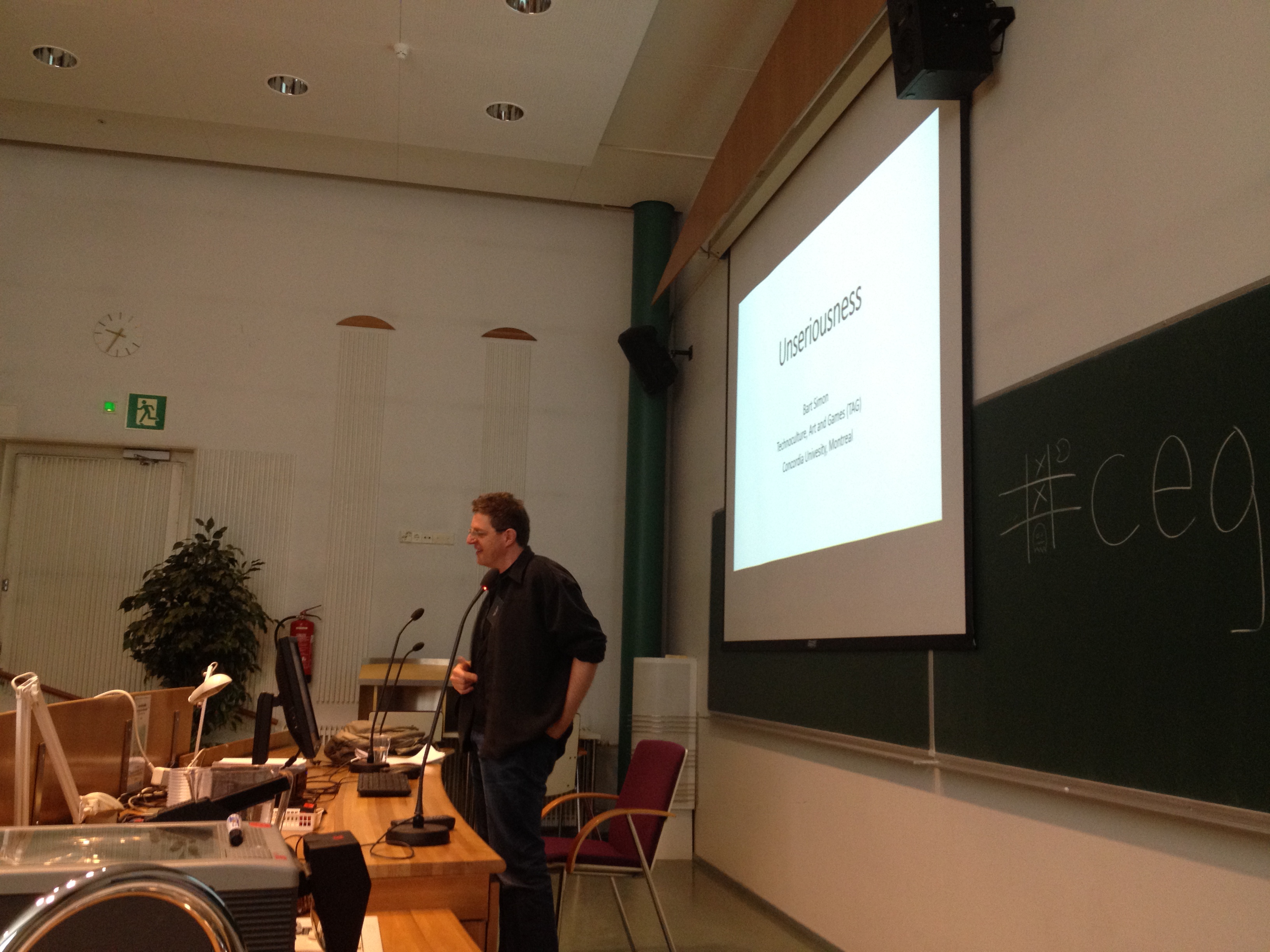
The Critical Evaluation of Game Studies seminar closed today, leaving a full house of tired but intellectually stimulated games scholars to debate and reflect on the outcomes and overall synthesis of the varied papers and discussions. One of the threads of the discussion concerned the identity and character of Game Studies (or “game studies”, or: games research? Or: ludology, even?) In his keynote, Espen Aarseth talked about Game Studies as a field, and argued (with explicit comment against my earlier published views) that a “discipline” is something that he particularly does not want to see Game Studies developing into.
This particular, anti-disciplinary view can in a way be grounded on the existing polyphony in this field: there has not emerged any single, unified school of thought that would encompass everything that is going around games and play in academia. On the other hand, one could also – again following Espen – argue that a discipline that produces its own undergraduates as well as postgraduates would need a more solid methodological basis, and also more established work market to guarantee the employment of such “native graduates”. (Sebastian Deterding had an interesting analysis and proposal in his paper, suggesting that since there are not much guarantees of employment, or not so many well-established publication venues in the “core” areas of Game Studies, people are escaping back to more established academic fields, such as HCI or Communication Studies, which have already opened up for games related research, and provide more institutional work opportunities – and that Game Studies should merge with Design Research so that it would have better opportunities for survival.) Or, one could follow Bart Simon who in his speech talked about the “unseriousness” inherent in games and play as an object of study, and go against the instrumentalization and reification of disciplinary knowledge by principle.
While I see the point of all these, well-grounded arguments, I just want to emphasize again that Game Studies needs both dimensions and movements: both the elements that pull people towards each other and focus at organizing the knowledge production and educational activities in Game Studies into some, hopefully rather unified wholes, as well as more interdisciplinary elements that fertilize and stimulate the growth of new approaches and innovations – both within Game Studies, as well as in other fields of learning. While there is enough anarchist in most game scholars today to make us stand up and go against any attempt at governance or “central control” in this daring, iconoclastic intellectual project that has been set into motion, it is also important, I think, to carry enough responsibility to aim at positive conditions for such project, and sometimes this will also require setting up “disciplinary versions” of the fast-moving research field, so that it can engage with various academic institutions and neighbouring disciplines at even terms. While such “freeze frame” simplifications of the field probably always do some violence to the plurality, coverage and dynamism of Game Studies, they are probably necessary illusions that we also need. Textbooks, lectures and articles are all good places to construct such, identity creating moments of Game Studies, as well as for deconstructing and questioning them. After the seminar, I think that the deconstructionist momentum is currently stronger than the constructivist one, but it just may be my impression.
In any case, I came out of the seminar invigorated and energized, believing even more that before to the need and enormous potential Game Studies has to offer, not only to academia, but also to the surrounding society. If we do not try to fit together and negotiate the multiple aspects that complicate the superficial, commonplace perceptions of what games are, or what game playing means, who is going to do that? Also, I do not think that the other academic disciplines that I know about are that much more unified, or less polyphonic than Game Studies is, actually. As years and decades go past, academics tend to question the truths of their fields from multiple angles, and come up with dozens of different, mutually competing and incompatible theories and approaches into their fields of inquiry. And that is a very good thing. Long live Game Studies, one and many!
Kutsu: Informaatiotutkimuksen päivät 2014
Informaatiotutkimuksen yhdistys ry järjestää Informaatiotutkimuksen päivät Oulussa 6. - 7. marraskuuta 2014. Päivillä tarkastellaan informaatioalan ilmiöitä laajasti sekä tutkimuksen, opetuksen että ammattikäytäntöjen näkökulmista. Etsimme nyt järjestettäviä työryhmiä ja niiden teemoja. Esitä työryhmää ilmoittamalla sähköpostitse Terttu Kortelaiselle (terttu.kortelainen@oulu.fi) 28. maaliskuuta 2014 mennessä seuraavat tiedot:

1. Työryhmän teema

2. Työryhmän vetäjä(t) (nimi, organisaatio)

3. Vetäjien sähköpostiosoitteet

4. Lyhyt kuvaus työryhmän teemasta sekä siitä, millaisia esityksiä ryhmään toivotaan.

5. Esitysten kieli, muoto

6. Muuta huomioitavaa (tila, tekniikka tms. toiveet).

Tarkempia ohjeita on liitetiedostossa.

Informaatiotutkimuksen yhdistyksen ja Informaatiotutkimuksen oppiaineen puolesta

Terttu Kortelainen

''''''''''''''''''''''''''''''
Terttu Kortelainen

FT, dosentti
Yliopistonlehtori
Humanistinen tiedekunta / Informaatiotutkimus PL 1000
90014 Oulun yliopisto
p 0294 48 3355
fax 08 344 790

PhD, docent
University lecturer
Faculty of Humanities / Information Studies P.O. Box 1000
FIN-90014 University of Oulu
Finland
tel +358 294 48 3355
fax +358 8 344 790
Applications open for Master’s Degree Programme in Internet and Game Studies
The application round for the master’s degree programmes given in English at the University of Tampere is now open. The application deadline is 31 January 2014. One of the open programmes is the Master’s Degree programme in Internet and Game Studies; you can find more information about it from here: http://www.uta.fi/sis/en/iti/mastersprogramme/igs.html.
Information on the master programmes and on how to apply is available at http://www.uta.fi/admissions/degreeprog/applying.html.
More information from Ms. Kirsi Tuominen http://www.uta.fi/sis/yhteystiedot/henkilokunta/kirsimarjatuominen.html.
Vastaväitös: nettipokeriaiheinen väitöskirja
[I will be the public opponent of a poker experience PhD study tomorrow in Helsinki] Huomenna on Helsingin yliopistossa mielenkiintoinen väitöstilaisuus, missä minulla on kunnia toimia vastaväittäjänä:
| Tapahtumaluokka: | Väitöstilaisuus |
| Aika: | pe 29.11.2013 klo 12:15 |
| Paikka: | Päärakennus, Auditorium XII, Unioninkatu 34 |
FM Jussi Palomäki väittelee 29.11.2013 kello 12.15 Helsingin yliopiston käyttäytymistieteellisessä tiedekunnassa aiheesta “New perspectives on emotional processes and decision making in the game of poker – with special emphasis on the tilting phenomenon”. Väitöstilaisuus järjestetään osoitteessa Päärakennus, Auditorium XII, Unioninkatu 34.
Vastaväittäjänä on professori Frans Mäyrä, Tampereen yliopisto, ja kustoksena on professori Heikki Summala.
Väitöskirja julkaistaan sarjassa Studies in Cognitive Science. Väitöskirja on myös elektroninen julkaisu ja luettavissa E-thesis -palvelussa.
http://helsinginyliopisto.etapahtuma.fi/Default.aspx?tabid=304&id=7487
 frans goes blog
You must be logged in to post a comment.